Relationship Building (Soft Skills)
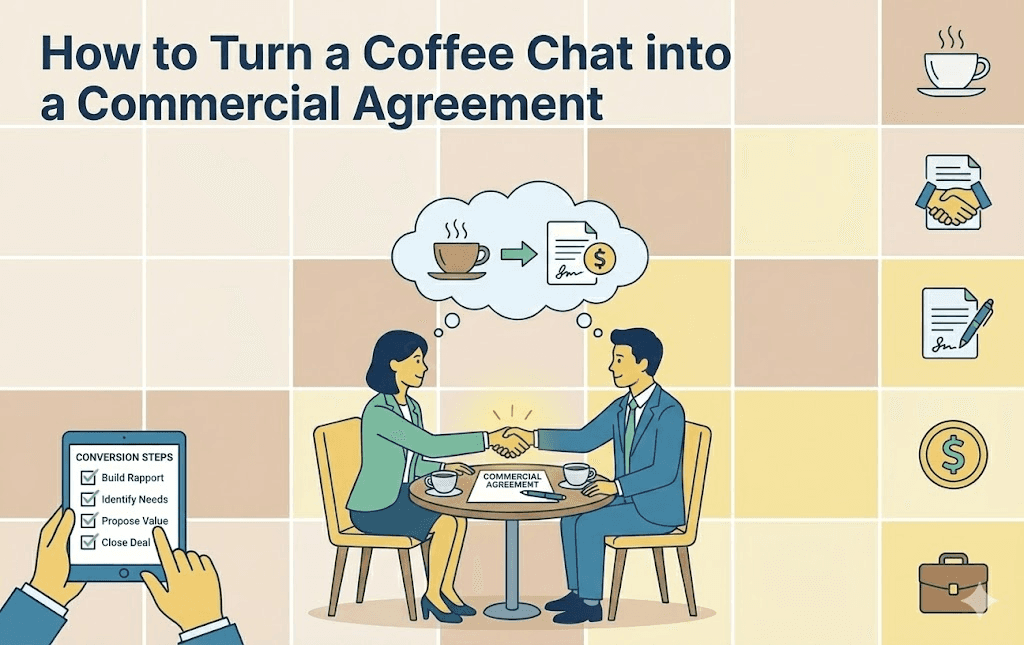
How to Turn a Coffee Chat into a Commercial Agreement
Date
Sep 8, 2025
Author
Matt Astarita
Struggling to monetize your network? Let's clear the air. You probably have 5,000 LinkedIn connections and a calendar full of "catch-ups." But if your P&L doesn't reflect that activity, you are just engaging in Professional Tourism.
In 2026, the "Let's grab coffee" meeting is the most dangerous event in your calendar. It feels like work. It looks like work. But usually, it is just procrastination.
The "Partnership Friend Zone" is where deals go to die. You talk about the market, you complain about your bosses, you agree there is "synergy," and then you part ways with: "Let's definitely find a way to work together."
Six months later? Nothing.
Here is how to structure a casual meeting so that it ends with a deal, not a platitude.
Phase 1: The Pre-Frame (Stop "Picking Brains")
The failure happens before the coffee is poured. If you ask for a meeting to "pick their brain" or "connect," you have set the expectation of Low Value.
The Strategy: The Hypothesis Invite. Never enter a meeting without a thesis.
Weak Invite: "Hey, long time no see. Let's grab coffee next week?"
Strong Invite: "Hey, I noticed you just launched the Shopify integration. I have a specific idea on how we could drive 500 leads to it next month. Up for a coffee to pressure-test it?"
Now, you aren't meeting to chat. You are meeting to evaluate a business case.
Phase 2: The "20-Minute Pivot"
You have 30 minutes. Most people spend 25 minutes on small talk and 5 minutes rushing the ask. You need to invert this.
The Protocol:
Minutes 0-5: Rapport (Kids, weather, sports). Build the human bridge.
Minutes 5-15: Discovery (Their Pain). Ask: "What is the one metric your Board is grilling you on right now?"
Minute 16 (The Pivot): You must physically shift the energy. Put your coffee cup down. Lean in.
The Script:
"That’s interesting. Listen, I don't want to just chat. Based on what you said about [Their Pain], I think there is a specific play we could run together. Do you want to hear it?"
You have asked for permission to pitch. They will always say yes. Now, the context has shifted from "Friends" to "Partners."
[Internal Link Opportunity]: Link this section to Article #51: "What is Strategic Intent?" to show how to align your pitch with their goals.
Phase 3: The "Paper Napkin" MOU
This is the most powerful soft skill in your arsenal. People buy Visuals, not words.
When you explain the partnership idea, do not just talk. Pull out a notebook (or a literal napkin). Draw two boxes.
Box A: Their Company.
Box B: Your Company.
The Arrow: The Value Flow (Leads, Data, Money).
The Psychology: When you draw, their eyes follow your pen. You are co-creating a reality. Point to the drawing and ask: "If we built this flow, would this solve that Board metric you mentioned?"
If they nod, you have a verbal agreement.
Phase 4: The "Draft" Follow-Up (The 15-Minute Rule)
The "Friend Zone" returns the moment you leave the room. You must cement the deal immediately. Do not wait 2 days. Do not send a "Great to see you" email.
Send a "Draft Framework" within 15 minutes (from the Uber/train).
The Email:
*"Great chat. To ensure I captured the idea correctly:
We integrate X.
You promote to Y.
We split revenue 50/50.
I’ve attached a 1-page bullet point draft. If this looks right, I’ll have legal wrap it up."*
Why this works: You aren't asking "Do you want to do this?" (which invites doubt). You are asking "Did I capture this correctly?" (which invites correction). Once they correct you, they are invested.
[Internal Link Opportunity]: Link this section to Article #30: "The Art of the Double Opt-In" to discuss clear communication protocols.
The "No-Go" Signal
Sometimes, the coffee chat reveals there is no deal. Be the one to call it.
If they don't have budget or bandwidth, say:
"It sounds like you guys are swamped right now. Let's not force a partnership. Let's just stay friends and revisit in Q4."
This creates High Status. You aren't desperate. Paradoxically, this often makes them want to work with you more.
The Verdict for 2026
Your network is your net worth, but only if you have the courage to activate it.
The difference between a "Contact" and a "Contract" is the letter R. R stands for Rigor. Bring rigor to your coffee chats, and you will never pay for your own latte again.