Founders & CEOs
Leveraging "Ego-Bait" to Attract High-Value Partners
Date
Oct 24, 2025
Author
Matt Astarita
You want to partner with a major player in your industry, let's call them BigTech Corp.
You have tried cold emailing their VP of Partnerships. Ignored. You have tried messaging their CEO on LinkedIn. Ignored. You have tried submitting a form on their "Become a Partner" page. Radio silence.
Why? Because you are asking for a favor before you have offered value.
If you want to skip the line and get a direct response from a decision-maker, you need to change the dynamic. You need to stop pitching and start featuring.
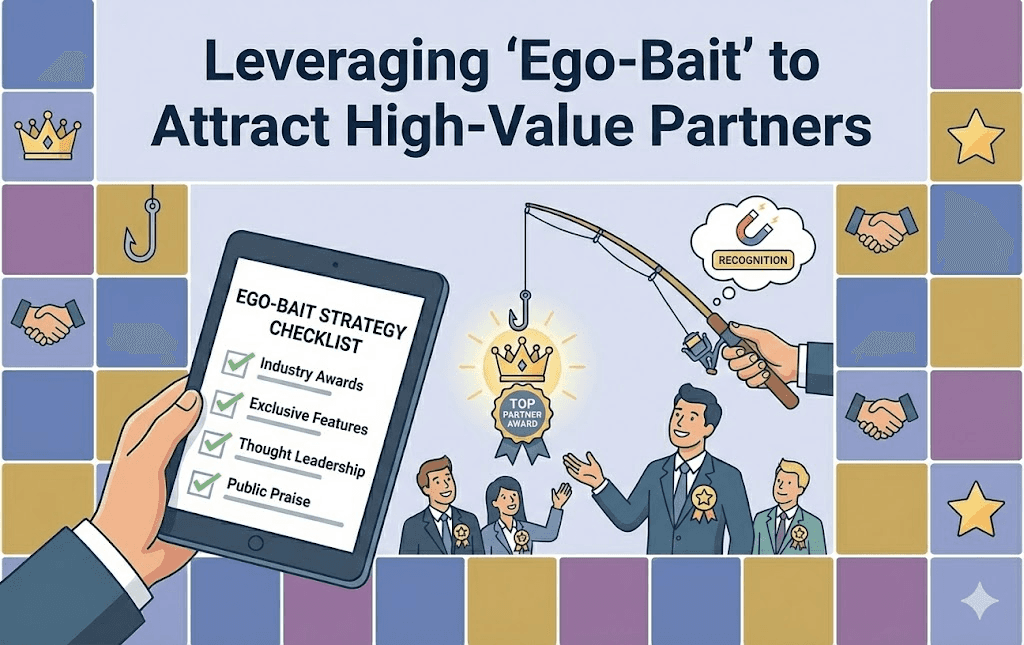
We call this strategy "Ego-Bait."
It is the art of using content to flatter your target partner into a conversation. Here is how to use vanity as a strategic weapon to build your ecosystem.
Jump to a section:
The Psychology: Why Ego-Bait Works
Playbook A: The "Top 50" List
Playbook B: The "Expert Interview" (Trojan Horse)
The Pivot: Turning Content into Commerce
1. The Psychology: Why Ego-Bait Works
Every executive, no matter how busy, has an ego. They want to be seen as a Thought Leader. They want their company to be recognized as an innovator.
The Cold Email Dynamic:
You: "Can I have 15 minutes of your time?"
Them: "No, my time is scarce."
The Ego-Bait Dynamic:
You: "I am featuring the top innovators in Fintech, and I want to include you. Can I have 15 minutes to get a quote?"
Them: "Yes, I would love to be included."
You are no longer a salesperson; you are a journalist. You aren't taking value; you are giving exposure. This lowers their defensive shield instantly.
[Internal Link Opportunity]: Link this section to Article #1: "Why 90% of Your Partnership Emails Are Being Ignored" to contrast this method with the failed "ask-first" approach.
2. Playbook A: The "Top 50" List
This is the easiest way to start relationships with 50 partners at once.
The Strategy: Create a blog post or industry map titled: "The Top 50 [Industry] Tools You Need in 2026."
The Execution:
Identify Targets: Pick 50 companies you want to partner with.
The Outreach: Send an email saying: "Hi [Name], we are including [Company] in our upcoming 'Market Map of 2026.' Just wanted to verify your logo and description. Also, here is a badge you can use on your site."
The Result: They will reply. They will thank you. They will share the post (free distribution).
Now, you are no longer a stranger. You are the company that promoted them. You have Relational Capital.
[Internal Link Opportunity]: Link this section to Article #33: "The Founder’s Guide to B2B Partnerships" to explain why Founders should lead this initiative to give it weight.
3. Playbook B: The "Expert Interview" (Trojan Horse)
If you need to get deep with one specific high-value partner (e.g., a potential acquirer or major integrator), use the Podcast/Webinar strategy.
The Strategy: Invite their VP of Product or CEO onto your podcast (or a co-hosted webinar).
The "Trojan Horse" Effect: The podcast episode is not the goal. The Pre-Show and Post-Show chatter is the goal.
You spend 45 minutes recording content.
But you spend the 15 minutes after the recording saying: "By the way, off the record—I loved what you said about API standards. We’re actually building something that solves that. I’d love to get your feedback on it next week."
Because you just spent an hour making them look smart, they will almost always agree to the follow-up call. You have turned a "Cold Pitch" into a "Warm Follow-up."
[Internal Link Opportunity]: Link this section to Article #30: "The Art of the Double Opt-In Introduction" to show how you are manufacturing your own warm intro.
4. The Pivot: Turning Content into Commerce
The danger of Ego-Bait is getting stuck in the "Friend Zone." You become a media partner, not a commercial partner.
You must pivot the relationship.
The Pivot Script: About 2 weeks after the content goes live (and performs well), you send the email:
*"Hey [Name], the piece we did together is crushing it—over 5,000 views already. It’s clear our audiences have a lot of overlap.
Since we’re already driving traffic to each other, should we look at formalizing a referral agreement or a lightweight integration to capture this demand?"*
Why it works: You are using Data (the content views) to prove the partnership value. It’s not a guess anymore; it’s a verified opportunity.
The Verdict
Ego-Bait is not manipulation; it is a Value Exchange. You give them status and distribution. They give you attention and access.
If you are a small startup trying to punch above your weight class, stop knocking on the front door. Build a stage, invite them to speak on it, and shake their hand when they walk off.