Metrics, Data & Attribution
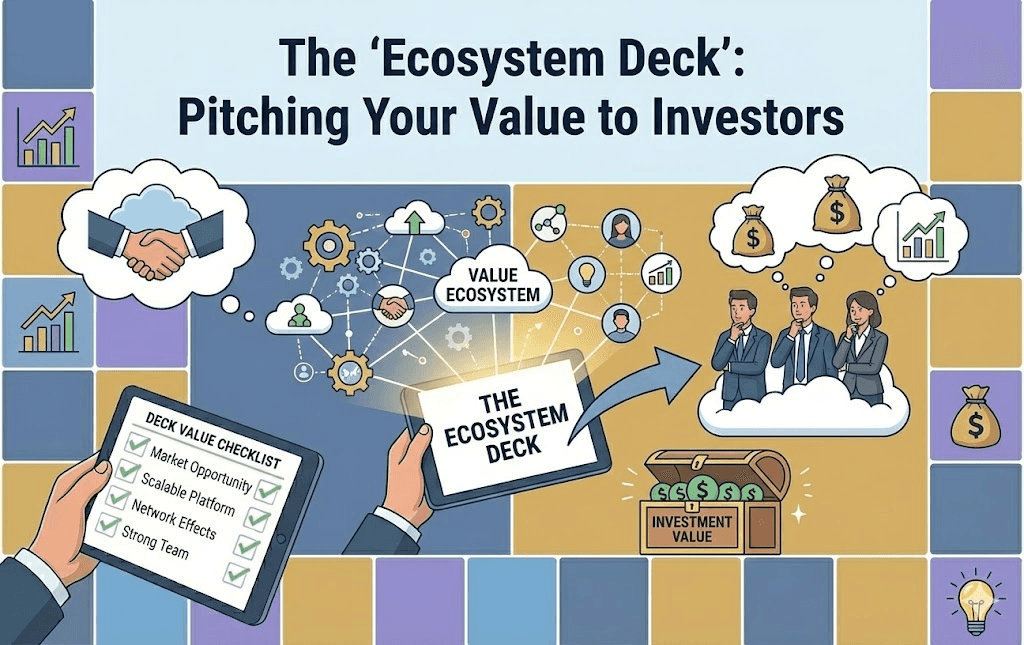
The "Ecosystem Deck": Pitching Your Value to Investors
Date
Oct 19, 2025
Author
Matt Astarita
Struggling to explain to your Board why you need headcount for a "Partnerships Manager"? Let's clear the air. Investors do not buy products. Products in 2026 are commodities; AI can write code faster than your engineers can.
Investors buy Moats. And in an age of infinite software supply, the only defensible moat left is a Network Effect.
If you pitch your company as a "Tool," you get a 5x revenue multiple. If you pitch your company as a "Platform" with an ecosystem, you get a 10x multiple.
The "Ecosystem Deck" is not for customers. It is for the Board, the VCs, and the future Acquirers. Here is how to construct the narrative that proves your valuation is justified.
Slide 1: The "Defense" (Churn Prevention)
VCs are terrified of Churn. Your first slide must prove that partners make your product impossible to rip out.
The Narrative: "Integration Density."
Data Point: "Customers with 0 integrations churn at 10%. Customers with 3+ integrations churn at 1%."
The Visual: A bar chart showing Churn Rate dropping as Integrations rise.
The Argument:
"We aren't just a destination; we are a hub. Once a client connects their CRM, their Billing, and their Email tool to us, leaving us becomes an operational nightmare. We have engineered 'High Switching Costs'."
Slide 2: The "Offense" (CAC Efficiency)
In 2026, the "Burn Multiple" (how much cash you burn to add $1 of ARR) is the North Star metric. Direct Sales is expensive (Burn Multiple of 2.0). Ecosystem is cheap (Burn Multiple of 0.5).
The Narrative: "The Invisible Sales Force."
Data Point: "30% of our new revenue is sourced by partners with $0 marketing spend."
The Visual: A comparison of LTV:CAC Ratios.
Direct: 3:1.
Partner: 8:1.
The Argument:
"While our competitors are bidding up expensive keywords on Google, we are leveraging the trust of 500 agencies who sell us for free. This allows us to grow faster while burning less cash."
Slide 3: The "Expansion" (NDR)
Net Dollar Retention (NDR) drives valuation. Investors want to see that existing customers pay you more every year. Partners unlock the "Upsell."
The Narrative: "The Service Layer."
Data Point: "Customers working with a specialized Solution Partner expand their usage by 40% YoY."
The Logic: Partners (Consultants) teach the customer how to use the tool better. Better usage = Higher tier upgrades.
The Argument:
"We don't need to hire a massive Customer Success team. Our Agency partners do the training and consulting for us. They drive adoption, we capture the upsell."
[Internal Link Opportunity]: Link this section to Article #64: "MarTech Integrations" to show how agencies drive retention.
Slide 4: The "M&A" Roadmap (The Exit)
This is the slide nobody talks about, but every investor thinks about.
"Who is going to buy this company for $1 Billion?"
The answer is always: A Strategic Partner. Salesforce bought Slack because of the integration. Adobe bought Figma for the workflow.
The Narrative: "Strategic Alignment."
The Visual: A map of the ecosystem showing your deep ties with the "Gorillas" (e.g., Microsoft, HubSpot, Shopify).
The Point: Show that you are so deeply embedded in their stack that acquiring you is the logical next step for them.
The "Appendix" Data (Due Diligence)
If the pitch goes well, they will dig into the data room. Have these 3 spreadsheets ready:
The "Attach Rate" Report: What % of deals have a partner involved? (Goal: Trending up).
The "Partner Concentration" Risk: Are you dependent on one partner for 80% of revenue? (Goal: <20%).
The "Tech Ecosystem" Map: A list of all live API integrations and their usage volume.
The Verdict for 2026
Don't pitch "Partnerships" as a department. Pitch it as a Business Model.
Department: "We manage relationships." (Cost Center).
Business Model: "We use an ecosystem to lower CAC, increase NDR, and build a defensive moat." (Revenue Engine).
The former gets a budget cut. The latter gets a Series B.