Advanced Ecosystem Ops & The Agentic Future
The "Compound Workflow": Building Multi-Partner Solutions
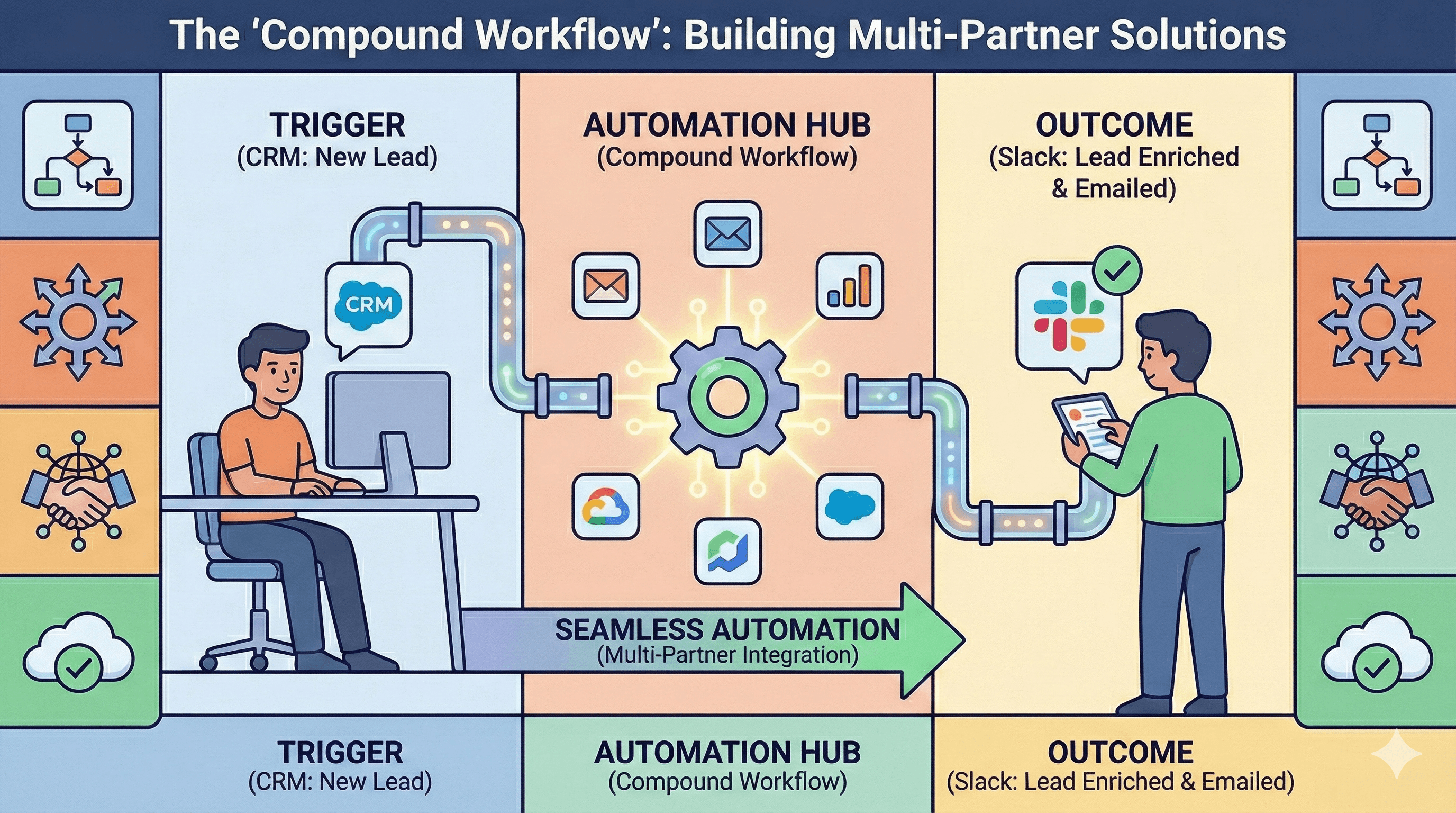
Date
Jan 16, 2026
Author
Matt Astarita
A long list of logos is not a feature. It is a Cognitive Load.
In 2026, customers are tired of playing "System Integrator." They don't want to buy Tool A, connect it to Tool B, debug the connection with Tool C, and hope it all works. They want a Solved Problem.
The future of ecosystems is not about how many partners you have. It is about how many partners you can chain together to automate a complete business process. Welcome to the era of the Compound Workflow. Here is how to move from 1:1 integrations to N-to-N solutions that customers actually want to buy.
The Death of the Point Solution
A simple integration solves a tech problem.
Example: "Sync Salesforce contacts to Mailchimp." (Boring. Low value).
A Compound Workflow solves a Business Problem.
Example: "Automate the entire 'Quote-to-Cash' process for a manufacturing firm."
The Workflow:
CPQ Partner (e.g., DealHub): Sales rep generates a complex quote.
E-Signature Partner (e.g., DocuSign): Customer signs the quote.
ERP Partner (e.g., NetSuite): The signed quote automatically turns into an Invoice and a Work Order.
Payment Partner (e.g., Stripe): The customer pays the invoice.
Four different partners, acting as one seamless machine. The customer didn't buy four tools; they bought "Automated Revenue."
The Strategy: The "Anchor Tenant" Model
You cannot build these workflows randomly. You need a center of gravity. Every Compound Workflow has an Anchor Tenant—the platform where the user spends most of their time (usually the CRM, ERP, or Vertical OS).
Your Role:
If you are the Anchor: Your job is to orchestrate. You define the workflow and invite the best-in-class partners to fill the gaps.
If you are a Satellite (e.g., E-signature): Your job is to ensure your API is so flexible that it can be embedded into any Anchor's workflow without friction.
The Anchor gets the glory (the UI), but the Satellites get the volume (the API calls). Both win.
Read "Vertical SaaS 2.0" to see how Vertical platforms act as the ultimate Anchors.
The Tech Layer: Embedded iPaaS
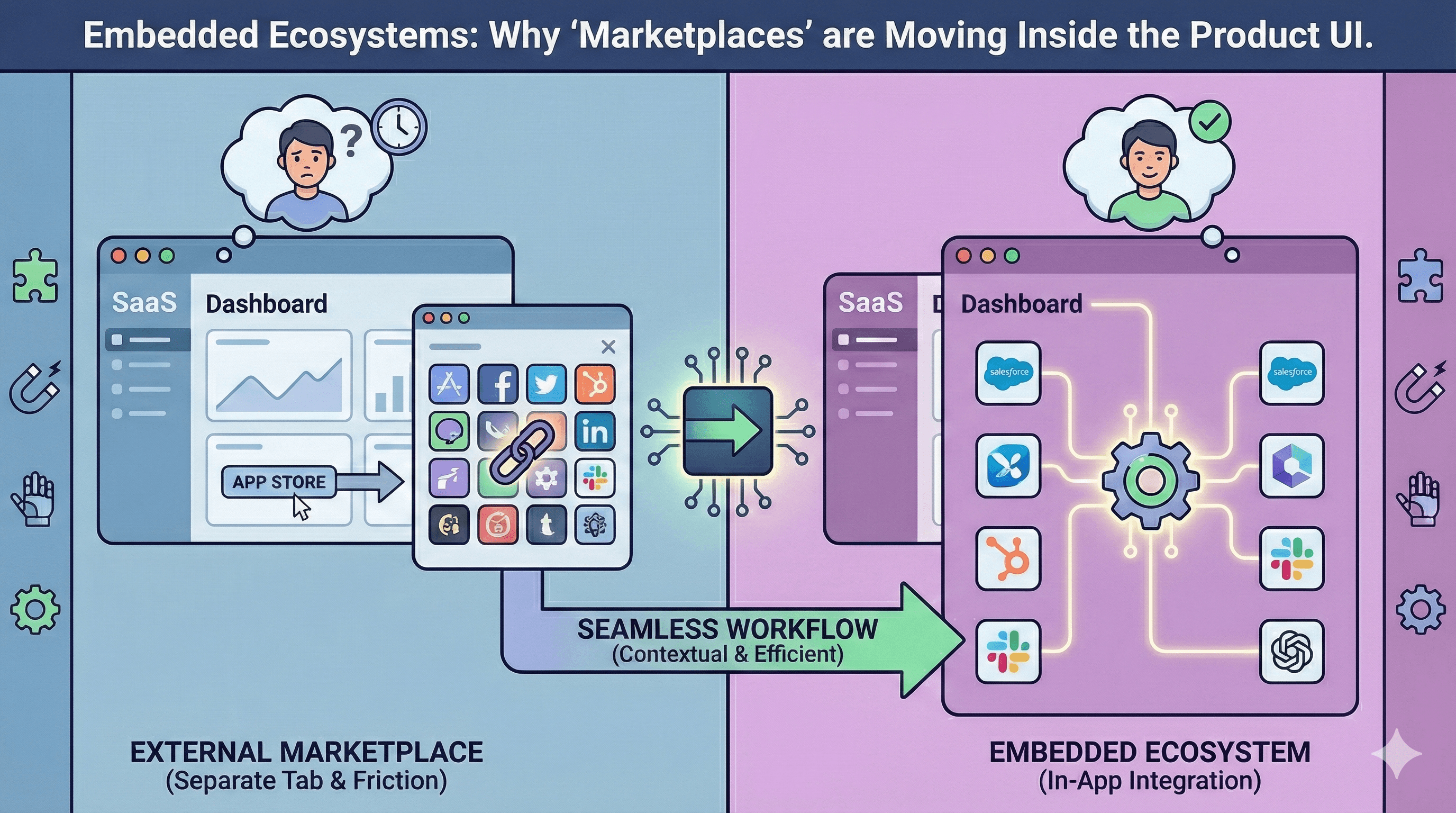
How do you actually connect four tools without making the user write code? In the past, you told the user to "Go use Zapier." That is too much friction for 2026.
The Solution: Embedded iPaaS (Integration Platform as a Service). Tools like Paragon, Prismatic, or Workato Embedded allow you to build these multi-step workflows inside your product and offer them as a native feature.
User Experience: They click "Enable Quote-to-Cash Workflow."
Behind the Scenes: Your embedded iPaaS handles the authentication and data mapping between all four partners invisibly.
The Business Model: The "Solution SKU"
This is the hardest part. How do you sell it? If the customer has to sign four separate contracts with four separate sales reps, the deal dies.
The 2026 Standard: The Unified SKU. The Anchor Tenant puts the entire bundle on their price paper.
The Offer: "Get the 'Manufacturing Automation Suite' for $5,000/month."
The Contract: The customer signs one agreement with the Anchor.
The Revenue Share: The Anchor automatically distributes the revenue to the three Satellite partners based on a pre-agreed Smart Contract.
This requires deep trust and sophisticated billing infrastructure (see Article #107 on IAP), but it is the only way to scale multi-partner solutions.
The "Agentic" Orchestrator
As we move further into 2026, these workflows won't be static "if-this-then-that" chains. They will be managed by AI Agents.
The Scenario: An order gets stuck in the ERP because inventory is low.
The Old Way: The workflow breaks. A human gets an error email.
The Agent Way: The "Workflow Agent" detects the error. It autonomously pings the Inventory Partner API to check restock dates, and then emails the customer an updated delivery timeline using the Email Partner.
The Agent acts as the "General Contractor," ensuring the subcontractors (partners) do their job even when things go wrong.
Read "Agent-to-Agent Commerce" to reinforce the agent-driven future.
The Verdict for 2026
Stop selling "puzzle pieces." Start selling the completed puzzle.
Don't market a list of 500 logos.
Do market 5 distinct "Solution Bundles" that solve your customers' most expensive problems.
The winners of the next decade will be the companies that can curate, orchestrate, and simplify complexity. Be the conductor, not just another instrument in the band.