Advanced Ecosystem Ops & The Agentic Future
Embedded Ecosystems: Why "Marketplaces" are Moving Inside the Product UI
Date
Jan 14, 2026
Author
Matt Astarita
Nobody wakes up in the morning and thinks, "I can't wait to browse the Acme SaaS Marketplace to see what's new."
In 2026, the standalone "App Store" is a graveyard. It requires a user to:
Leave your product.
Go to a website.
Search for a solution.
Install it.
Go back to your product.
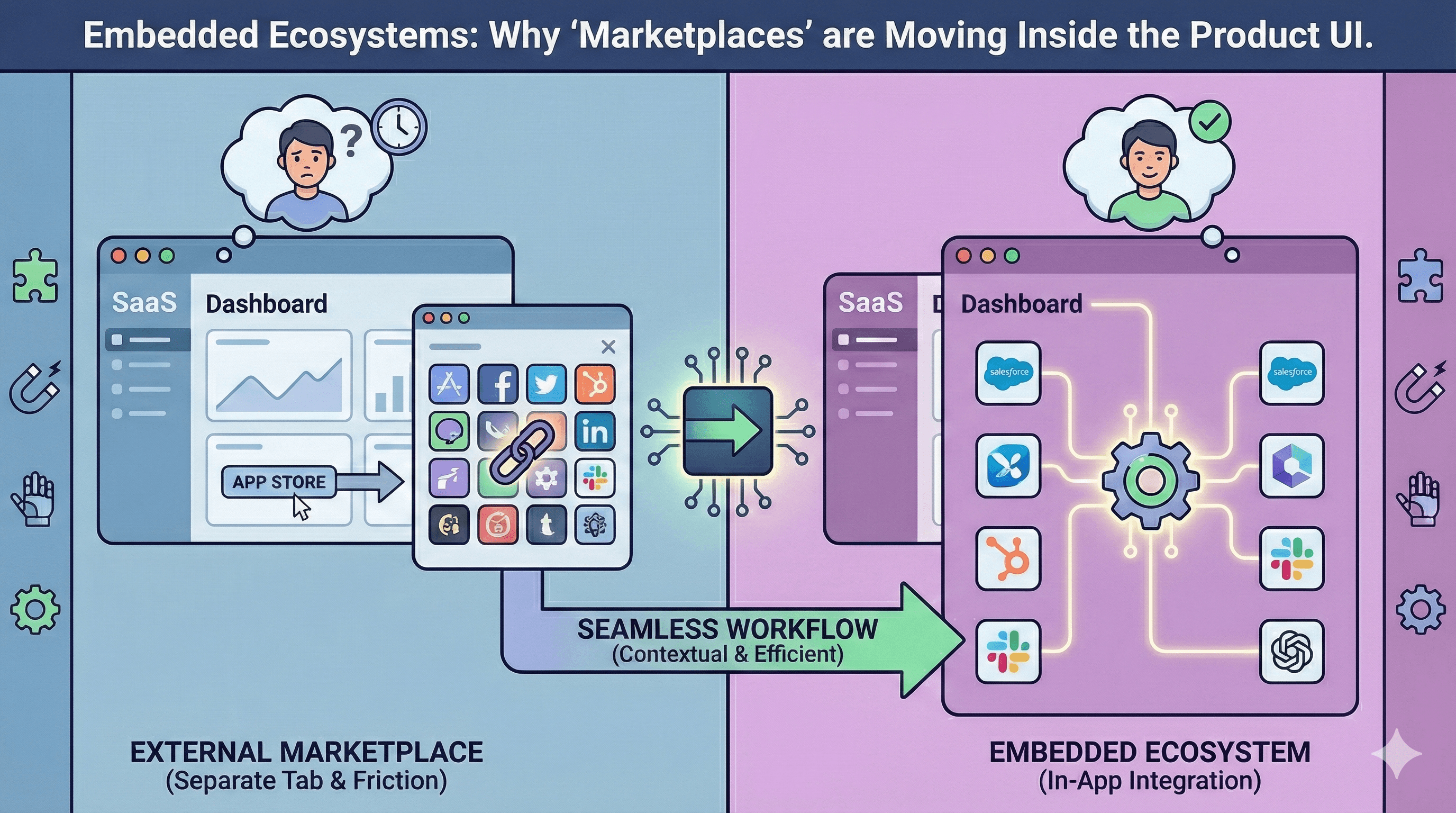
This is Friction. And friction is the enemy of revenue. The highest-performing ecosystems have stopped building "Destinations." They are building Embedded Experiences. The marketplace is no longer a place. It is a feature that appears exactly when the user needs it.
Here is how to move your partners from the "Directory" to the "Dashboard."
The "Just-in-Time" Discovery Model
Context is the new search engine. Users shouldn't have to search for an integration; the integration should find them based on what they are trying to do.
The Old Way: A user exports a CSV file, opens a new tab, logs into QuickBooks, and imports the CSV.
The Embedded Way: The user clicks "Export." A modal pops up: "Tired of CSVs? Turn on the QuickBooks sync to send this invoice automatically."
The Result: The conversion rate on "Contextual Prompts" is 10x higher than the conversion rate of a banner ad on a marketplace homepage. You are solving the problem in the moment of pain.
The "Empty State" Opportunity
The most valuable real estate in your software is the Empty State. When a user clicks on a feature they haven't used yet (e.g., "Analytics"), don't show a grey screen that says "No Data."
The Strategy: Show the Partner Solution.
UI Copy: "No data found. Connect Google Analytics or HubSpot to populate this dashboard instantly."
Action: One-click OAuth flow.
This turns your "Empty States" into "Partner Billboards." It teaches the user that the way to get value from your tool is to connect other tools.
The "Headless" Marketplace
In 2026, you don't need a "Storefront" UI (logos, ratings, reviews) inside your app. That takes up too much space. You need a Headless Marketplace.
The Tech: Your product engineering team consumes your Marketplace API to surface specific partners in specific dropdown menus.
In the "Email Settings" tab: The API surfaces only Mailchimp and SendGrid.
In the "SMS Settings" tab: The API surfaces only Twilio and Attentive.
The "Marketplace" is dissolved into the fabric of the product settings. The user doesn't even know they are "shopping." They are just "configuring."
Read "Vertical SaaS 2.0" to show how vertical platforms master this specific workflow.
IAP for B2B (In-App Purchasing)
We are used to "In-App Purchases" in mobile games (buying extra lives). In 2026, this model dominates B2B.
The Friction Point: Usually, finding a partner is easy, but paying for them is hard. You have to go to the partner's site, enter a credit card, and sign a contract.
The Fix: Unified Billing.
The Offer: "Enable the DocuSign integration for $10/month. Added directly to your existing bill."
The Magic: One click. No new credit card. No new vendor onboarded.
You (the Platform) act as the Merchant of Record. You collect the money and pay the partner their revenue share programmatically. This turns your ecosystem into a revenue stream, not just a feature set.
The "Agentic" Hand-Off
With the rise of AI Agents, the "Embed" goes even deeper.
User: "Analyze my sales data."
Your AI: "I can do that, but I see your data lives in Snowflake. Shall I connect to the Snowflake Partner API to fetch the raw rows?"
The AI suggests the integration as a tool it needs to complete the task. The user grants permission. The partnership is activated by the Agent, not the Human.
Read "Agent-to-Agent Commerce" to go further with the agent workflow.
The Verdict for 2026
If your partners are hidden in a "Resources" tab on your website, you are failing them.
Don't make users search.
Do make users stumble upon the solution.
Your Product Manager is now your most important Partnership hire. Sit with them. Look at the UI wireframes. Ask: "Where is the pain? And which partner solves it right there?"
Embed the solution, and the adoption will follow.