The Shift
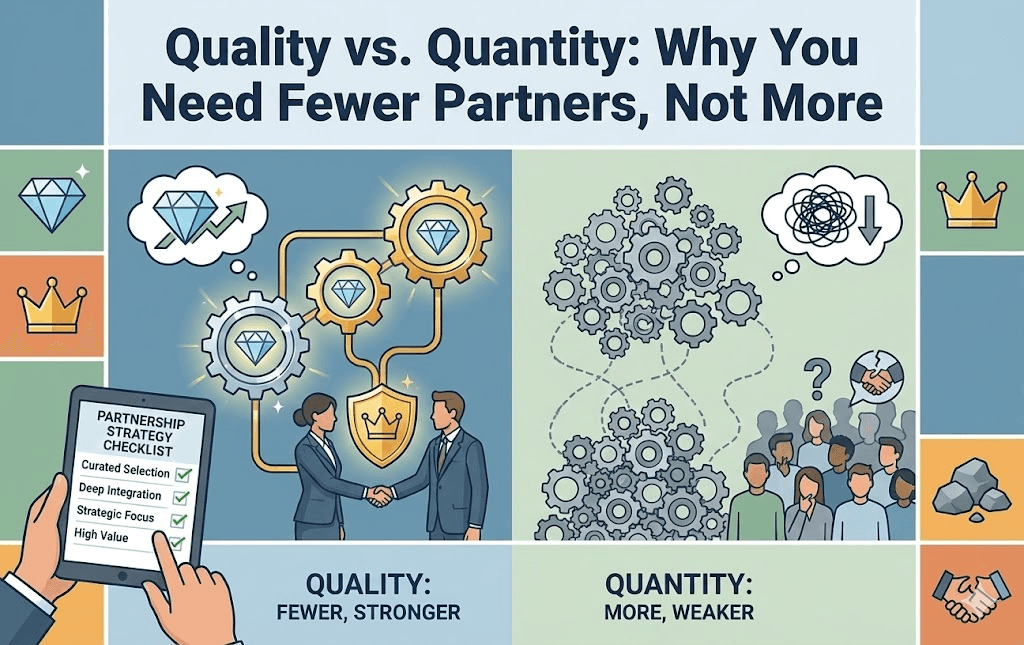
Quality vs. Quantity: Why You Need Fewer Partners, Not More
Date
Nov 1, 2025
Author
Matt Astarita
Visit almost any SaaS website, scroll to the bottom, and click "Partners."
What do you see? usually, it's a "Logo Wall", a digital trophy case displaying 200, 500, or even 1,000 company logos. It looks impressive. It signals scale. It tells investors, "Look at our massive ecosystem!"
But if you look under the hood, you will find a ghost town.
The uncomfortable truth about most partnership programs is that they are bloated. Companies are obsessed with recruitment (getting the logo) but terrible at activation (getting the revenue).
In the era of efficient growth, the "Logo Wall" is a vanity metric. Here is why you need to stop chasing volume and start firing your zombie partners.
Jump to a section:
The 95/5 Rule of Ecosystems
The Hidden Cost of "Zombie Partners"
The New Strategy: "Super Nodes"
How to Prune Your Program
1. The 95/5 Rule of Ecosystems
We are all familiar with the Pareto Principle (the 80/20 rule). In direct sales, 80% of revenue often comes from 20% of customers.
In partnerships, the ratio is even more extreme. It is usually 95/5.
5% of your partners are "Strategic." They understand your value prop, they map accounts with you, and they drive actual pipeline.
95% of your partners are "Paper Partners." They signed an agreement two years ago, listed you in a directory, and haven't spoken to you since.
If you have 100 partners, only 5 really matter. The other 95 are just noise.
The Verdict: You don't need a bigger funnel. You need a filter. A program with 10 active partners generating $1M is infinitely better than a program with 1,000 inactive partners generating $1.1M.
2. The Hidden Cost of "Zombie Partners"
A common objection is: "But having more logos doesn't hurt, right? It's free brand awareness."
Wrong. There is no such thing as a free partner.
Even inactive partners tax your resources. We call this the "Long Tail Drag."
Support Costs: They send low-quality support tickets that your team has to answer.
Legal/Ops: They require contract renewals and compliance checks.
Mental Bandwidth: Your Partner Managers waste hours answering "check-in" emails from partners who will never close a deal.
Every hour you spend managing a low-value partner is an hour you steal from a high-value one. If you are spread thin across 500 relationships, you cannot go deep with the 5 that actually move the needle.
⚡ Pro-tip: Calculate your "Partner Management Hour" cost. If a partner hasn't generated revenue exceeding the cost of the time you spend managing them, they are a liability, not an asset.
3. The New Strategy: "Super Nodes"
The most successful Ecosystem-Led Growth strategies in 2025 are shifting toward "Super Nodes."
A Super Node is a partner with high Strategic Intent and high Tech Overlap. Instead of trying to be "everywhere," you identify the 3-5 ecosystems where your customers already live and you double down.
For example, instead of having 50 mediocre marketing agency partners, find the two agencies that specialize exactly in your vertical and treat them like an extension of your sales team.
Give them shared Slack channels.
Map accounts weekly.
Offer higher commissions.
The result: You become their #1 recommended tool, rather than just another option in their directory.
4. How to Prune Your Program (and Find Better Matches)
If your partner list is bloated, it’s time to clean house. Here is a simple audit process:
The Revenue Test: Did this partner influence any revenue in the last 12 months? If no -> Move to Step 2.
The Intent Test: Are they actively engaging with your content or product? If no -> Deprecate.
Don't be afraid to send a "breakup email." Move them to a self-serve tier or remove them entirely.
Once you have cleared the noise, how do you fill the gap?
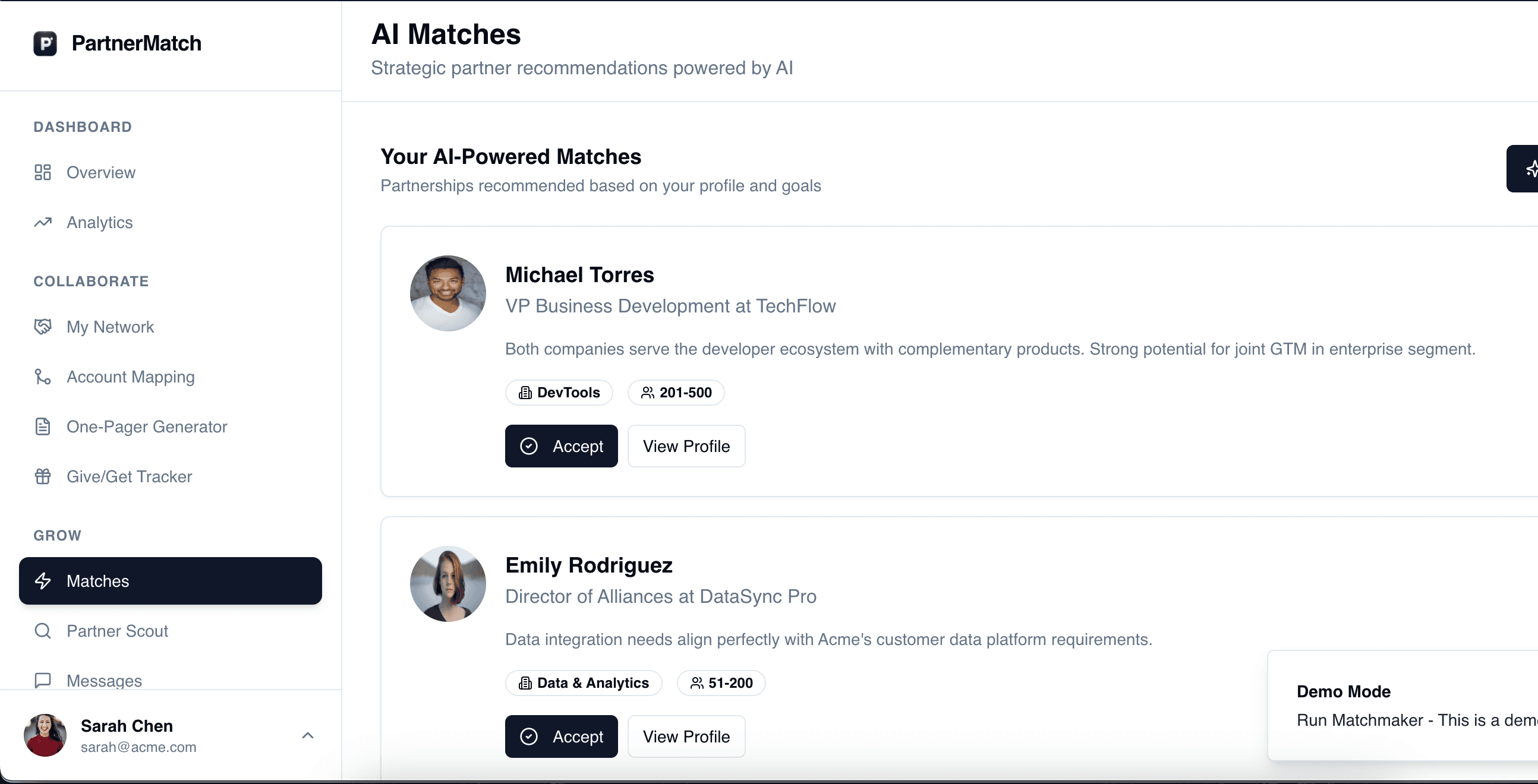
Stop "Recruiting" and Start "Matching." This is the core philosophy of PartnerMatch.co. We don't want you to find more partners. We want you to find the right partners.
By filtering for Strategic Intent (e.g., "Looking for integration partners in Healthtech"), you bypass the 95% of noise and go straight to the 5% of partners who are ready to act.
The Bottom Line
In 2026, ecosystem size is not a competitive moat. Ecosystem engagement is.
Stop collecting logos. Start building relationships.