Future Trends
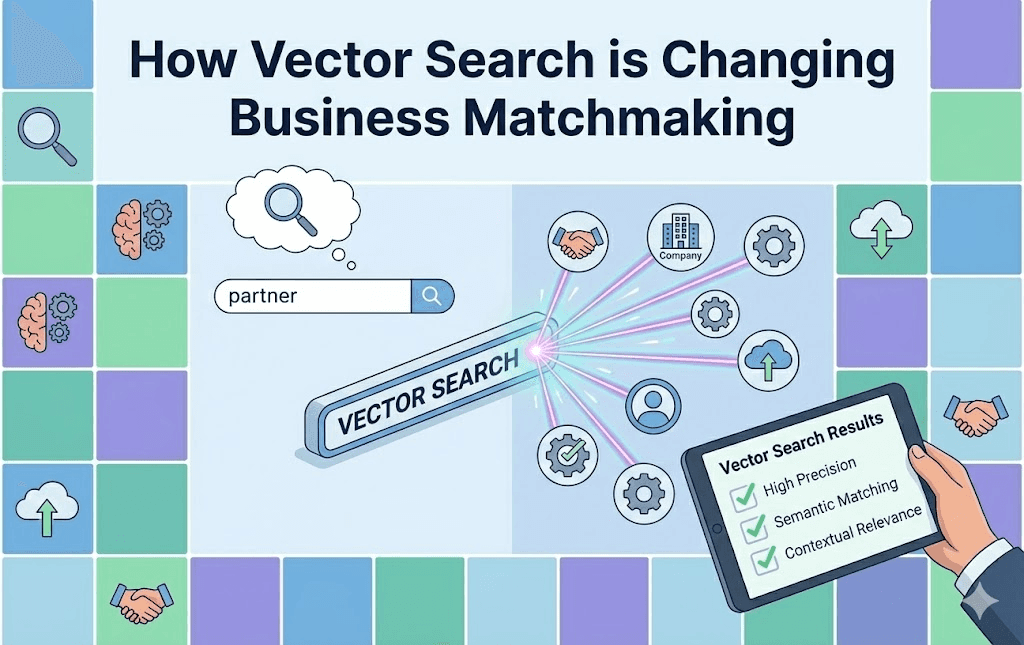
How Vector Search is Changing Business Matchmaking
Date
Oct 12, 2025
Author
Matt Astarita
Have you ever searched for something on a partner directory and gotten zero results, even though you knew the right partner was in there?
You type: "Financial Planning Software" -> 0 Results. But if you had typed: "Fintech Wealth Management" -> 50 Results.
This is the failure of Keyword Search. For the last 20 years, B2B matchmaking has relied on exact text matches. If you didn't guess the exact magic word the other person used to describe themselves, you missed the connection.
But in 2026, the search bar is getting a brain transplant.
We are moving from "Keyword Search" to "Vector Search." It is the technology behind ChatGPT, Netflix recommendations, and now, the engine behind PartnerMatch.co.
Here is how Vector Search turns math into money, and why it finds the partners you didn't even know you were looking for.
Jump to a section:
The "Keyword" Trap
What is Vector Search? (Simply Explained)
Finding "Conceptual" Synergies
1. The "Keyword" Trap
Old-school directories are "dumb." They look for a string of text.
If a potential partner describes themselves as a "Client Retention Platform" and you search for "Churn Reduction Tool," a keyword search sees them as different things.
[Internal Link Opportunity]: Link this section to Article #3: "Stop Buying Lists: Why Static Directories Don't Work" to reinforce the limitations of legacy tools.
This rigidity creates a massive "Missed Opportunity Gap." You walk right past your perfect partner because you used a synonym and they used an acronym. In a global market where partners describe their value in different languages and jargons, keywords are a broken compass.
2. What is Vector Search? (Simply Explained)
Vector Search doesn't read words; it reads meaning.
Imagine a 3D map of the universe.
Shutterstock
In this map, concepts that mean similar things are placed close together.
"King" is close to "Queen."
"CRM" is close to "Salesforce."
"Churn" is close to "Retention."
When you search, the engine doesn't look for a text match. It looks for a coordinate match. It drops a pin on the map where your query is and looks around to see who else is in the neighborhood.
This means if you search for "Help me lower my CAC," Vector Search understands that "Lead Scoring Software" and "PPC Agency" are conceptually related solutions, even if they don't share a single keyword.
3. Finding "Conceptual" Synergies
How does this apply to your ecosystem strategy?
It allows you to match based on Strategic Intent, not just categories.
[Internal Link Opportunity]: Link this section to Article #13: "Predictive Partnering" to connect vector search with prediction.
With PartnerMatch.co, we use Vector Search to analyze the "About Us" pages, API docs, and mission statements of every company in our network. We turn that text into vectors.
The Result: You might say: "I need a partner to help me break into the German Enterprise market."
A keyword search would look for "German Enterprise Partner." Our Vector Engine finds:
A System Integrator in Munich.
A Compliance Tool for EU data privacy (GDPR).
A Consultant who specializes in "DACH Region Market Entry."
The engine understands that GDPR Compliance is a prerequisite for German Enterprise, so it surfaces that partner as a high-relevance match.
The Verdict
Business is nuanced. Your search engine should be too.
Keyword search assumes you know exactly what you are looking for. Vector Search assumes you have a problem and helps you find the solution.
In 2026, don't just search for a label. Search for a meaning.