Founders & CEOs
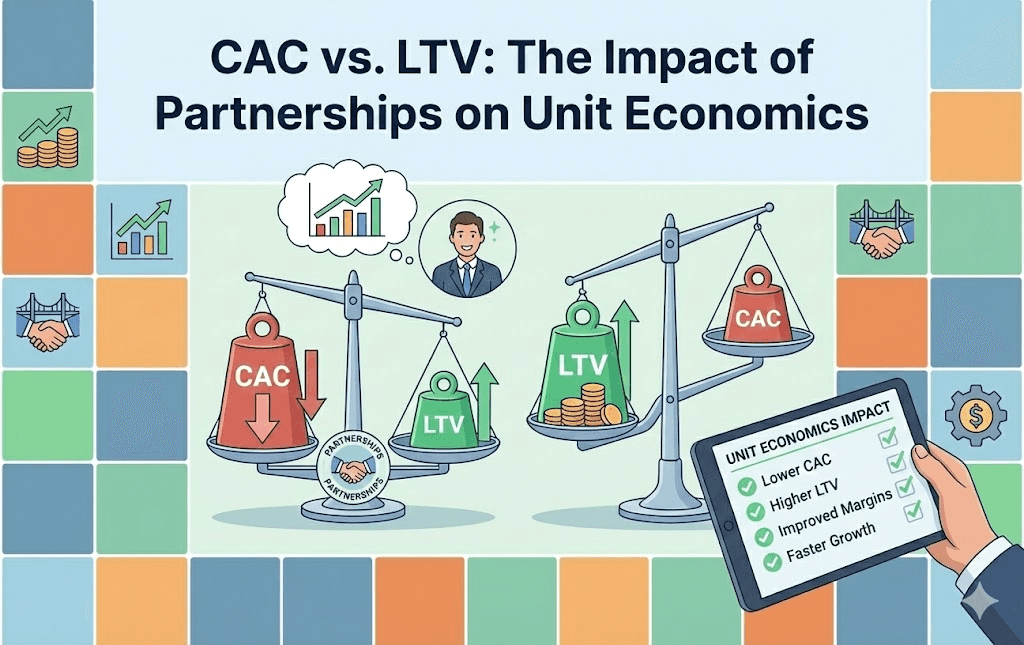
CAC vs. LTV: The Impact of Partnerships on Unit Economics
Date
Oct 14, 2025
Author
Matt Astarita
In the zero-interest rate era (ZIRP), Founders only cared about one metric: Top Line Growth. If you grew 100% YoY, nobody asked how much cash you burned to do it.
In 2026, the game has changed. The market doesn't reward "Growth at All Costs." It rewards "Efficient Growth."
Investors are looking at your LTV/CAC Ratio (Lifetime Value divided by Customer Acquisition Cost).
If your ratio is 1:1, you are dying.
If your ratio is 3:1, you are healthy.
If your ratio is 5:1, you are a unicorn.
Most Founders try to fix this ratio by optimizing Facebook Ads or tweaking pricing. But the most effective lever to manipulate both sides of this equation simultaneously is an Ecosystem Strategy.
Here is the mathematical case for why Partner-Led deals are the most profitable revenue on your P&L.
Jump to a section:
Fixing the Denominator: How Partners Slash CAC
Fixing the Numerator: How Integrations Boost LTV
The "God Metric": Why This Drives Valuation
The CFO’s Ledger: A Direct Comparison
1. Fixing the Denominator: How Partners Slash CAC
Direct Sales is expensive.
To acquire a customer directly in 2026, you pay for:
Marketing: Ads (CPCs are at all-time highs), Content, SDR tools.
Sales Headcount: Salaries, Commissions, Benefits.
Time: A 4-6 month sales cycle.
Partner Sales are efficient.
When a partner brings you a deal, they have usually already done the "Trust Building."
Near-Zero Marketing Cost: You didn't pay for the lead; the partner's relationship generated it.
Lower Sales Friction: Referrals convert 3-4x higher than cold leads. You don't need 10 SDRs making cold calls; you need 1 Partner Manager enabling 10 partners.
The "Rev-Share" Objection:
CFOs often argue: "But we have to pay the partner 20%! That hurts our margin."
The Counter-Math:
Paying 20% after the deal closes (Success Fee) is infinitely better than paying 100% of the CAC before the deal closes (Risk Fee).
Direct CAC: You spend $5k to get a $10k customer. (CAC Payback = 12 months).
Partner CAC: You pay $2k referral to get a $10k customer. (Instant Payback).
[Internal Link Opportunity]: Link this section to Article #32: "How to Scale Distribution Without Hiring a Sales Team" to reinforce the concept of variable cost vs. fixed cost.
2. Fixing the Numerator: How Integrations Boost LTV
Lowering CAC is great, but increasing Lifetime Value (LTV) is where the real wealth is created.
LTV is driven by Retention. And Retention is driven by Stickiness.
If a customer buys your software as a standalone tool, it is easy to rip out.
"Oh, we don't use this tool anymore. Cancel subscription."
If a customer integrates your software into their core stack (e.g., connecting it to Salesforce, Slack, and their Data Warehouse), ripping it out becomes painful. It breaks their workflows.
The "Attach Rate" Multiplier:
Data consistently shows that customers with 1+ Integrations have:
30-50% Lower Churn Rates.
Higher ACV (Average Contract Value): They buy more seats because the tool is more useful.
When you pursue an Ecosystem Strategy, you aren't just selling "licenses"; you are selling "connections." This mechanically extends the life of the customer.
[Internal Link Opportunity]: Link this section to Article #25: "3 Metrics That Actually Matter" to dive deeper into how to measure Partner Attach Rate.
3. The "God Metric": Why This Drives Valuation
When you lower the CAC (Denominator) and raise the LTV (Numerator), your efficiency ratio explodes.
Direct Go-To-Market:
LTV ($50k) / CAC ($15k) = 3.3x Ratio (Average).
Ecosystem Go-To-Market:
LTV ($75k due to retention) / CAC ($5k referral) = 15x Ratio (Elite).
Valuation Impact:
In 2026, Public Market Multiples are correlated to efficiency. A company with a 15x LTV/CAC ratio commands a significantly higher revenue multiple than a company grinding out a 3x ratio.
Investors see "Partner Revenue" as High-Quality Revenue because it is defensible and cheap to acquire.
[Internal Link Opportunity]: Link this section to Article #31: "Why Ecosystem-Led Growth is the New PLG" to explain why investors are shifting their focus to this model.
4. The CFO’s Ledger: A Direct Comparison
If you need to convince your finance team to give you budget, show them this table.
Metric
| Direct Outbound Deal
| Ecosystem-Led Deal
|
Lead Source
| Cold Call / Paid Ad
| Partner Referral / Integration
|
Sales Cycle
| 90 Days
| 45 Days (Trust already established)
|
Close Rate
| 20%
| 60%
|
CAC
| High (Fixed Salaries + Ad Spend)
| Low (Variable Rev Share)
|
Retention
| Average
| High (Technical Lock-in)
|
Net Dollar Retention
| 100%
| 120% (Cross-sell opportunities)
|
The Verdict
Partnerships are not a "Support Function." They are a Unit Economics Optimization Engine.
If you are a Founder looking at your burn rate and wondering how to extend your runway, the answer isn't to fire your sales team, it's to enable your ecosystem.
Stop paying full price for customers. Start leveraging the network.
[Internal Link Opportunity]: Link this section to Article #33: "The Founder’s Guide to B2B Partnerships" to zoom back out to the high-level strategy.