Product Leaders
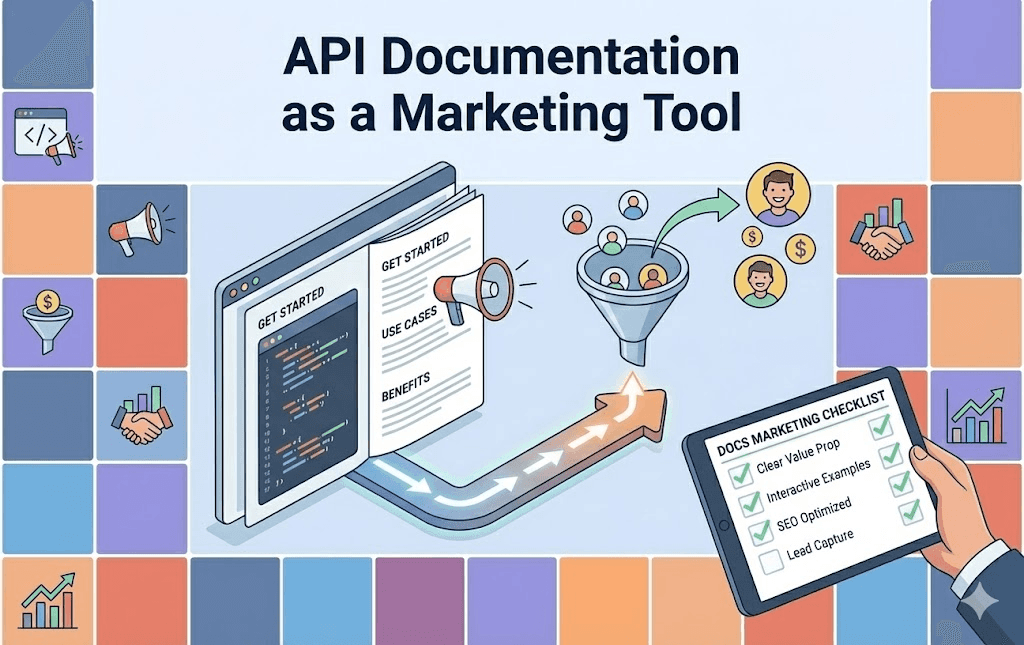
API Documentation as a Marketing Tool
Date
Oct 15, 2025
Author
Matt Astarita
Struggling to get developers to adopt your platform? Let's clear the air. The reason isn't usually your code. It’s your documentation.
In 2026, your API Documentation is your most important landing page.
Why? Because the modern B2B buying journey has changed. Before a VP signs a contract, they ask their Lead Developer: "Can we actually work with this?" The developer doesn't call your sales rep. They Google your docs.
If your documentation is a dry, static PDF hidden behind a login wall, you just lost the deal. If it is an interactive, use-case-driven experience, you just won a champion.
Here is how to transform your docs from a "Technical Manual" into a Conversion Engine.
Rethinking the "Target Audience"
The old days of writing docs purely for engineers who have already bought the product are gone. Thank goodness.
Today, developers are Evaluators. They are shopping.
They are looking for three things, and they want them in under 5 minutes:
Capability: Can this tool do what I need?
Ease: How painful will this be to build?
Trust: Is this API maintained and stable?
Your documentation needs to answer these questions visually and interactively. It is not "support content." It is Bottom-of-Funnel Marketing.
The "Time to Hello World" (TT_HW) Metric
In marketing, we measure "Time to Conversion." In Developer Experience (DX), we measure Time to Hello World.
Definition: How many minutes does it take a developer to land on your docs, get an API key, and make their first successful API call?
The Benchmark:
< 5 Minutes: World Class (Stripe, Twilio).
> 30 Minutes: Deal Killer.
If you require a developer to "Contact Sales" to get a sandbox key, you have failed the TT_HW test. You are adding friction where you should be adding fuel.
[Internal Link Opportunity]: Link this section to Article #41: "Build vs. Partner" to explain that product leaders choose partners who are easy to integrate with.
The "Marketing-Grade" Documentation Checklist
How do you tell if your docs are ready for 2026? Use this audit checklist.
Feature
| Standard Docs (The "Manual")
| Marketing Docs (The "Asset")
|
Access
| Hidden behind login/PDF.
| Public, indexed by Google (SEO).
|
Onboarding
| "Here is a list of endpoints."
| "Here is a 'Quick Start' guide."
|
Interactivity
| Static text.
| "Try it Now" button (Run code in browser).
|
Context
| Abstract variables (Foo/Bar).
| Real-world Use Cases (Create Customer).
|
Visuals
| Text only.
| Architecture Diagrams & Flowcharts.
|
Turning "Endpoints" into "Use Cases"
A common mistake is organizing docs alphabetically by endpoint.
GET /authPOST /billingGET /users
This is a dictionary, not a guide. Developers don't buy "endpoints." They buy solutions.
The Fix: Organize by Use Case.
Create a "Solutions" section in your docs that maps to your sales deck.
"How to Sync Contacts Real-Time"
"How to Automate Billing"
When a developer sees their specific problem written in the header, they stop evaluating the tool and start evaluating the solution.
[Internal Link Opportunity]: Link this section to Article #29: "How to Pitch Your Product to a Potential Integration Partner" to show how to align your pitch with your docs.
The "Trojan Horse" Strategy: SEO
Here is the hidden power of public docs: Long-Tail SEO.
Developers search for specific technical problems, not brand names.
Query: "How to sync Shopify inventory to SAP python"
Result: If your documentation page for that specific endpoint is optimized, YOU show up.
You capture the developer at the exact moment of intent.
Don't use no-index on your docs. Optimize them. Use clear H1s. Use schema markup for code snippets. Treat your API reference like a blog.
[Internal Link Opportunity]: Link this section to Article #14: "Intent Data vs. Identity Data" to categorize search traffic as high-intent signals.
The Verdict for 2026
Your API is a product. Your documentation is the packaging.
You wouldn't ship an iPhone in a brown paper bag. Don't ship your API in a black-and-white text file.
Invest in Developer Experience (DX). Make your docs beautiful, searchable, and runnable.
When the developer says, "I love their docs," what they are really saying is, "I am going to advocate for us to buy this."