Product Leaders
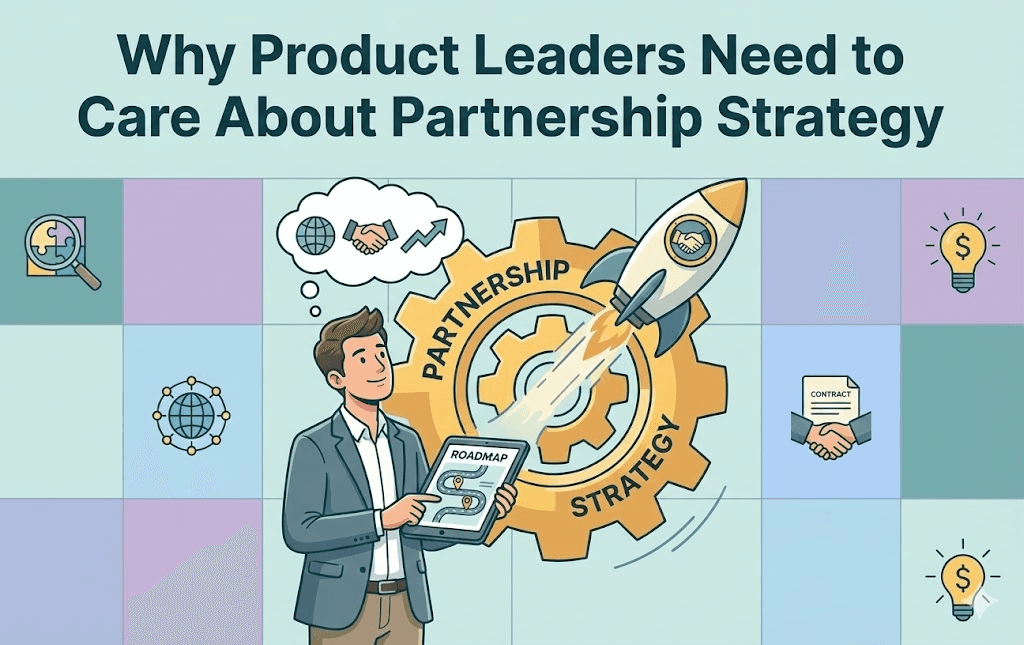
Why Product Leaders Need to Care About Partnership Strategy
Date
Sep 25, 2025
Author
Matt Astarita
Struggling to understand why the Partnerships team keeps asking for API updates? Let's clear the air. The modern Product Leader can no longer afford to view partnerships as a "Sales thing" or a distraction from the roadmap.
In 2026, the Product is the Ecosystem.
If you are building your product in a silo, focusing only on your own UI and your own features, you are building an island. And in a connected SaaS economy, islands starve.
The most successful CPOs today aren't just managing a backlog of user stories; they are architecting a Networked Product. Here is why your career trajectory depends on your ability to embrace ecosystem strategy.
Rethinking the Role of Product
The old days of "Build it and they will come" are over. Thank goodness.
Think of your product like a smartphone. A phone with no App Store is just a calculator. It has limited value. A phone with an App Store is a portal to infinite value.
As a Product Leader, your job isn't just to build the phone; it's to build the connectivity layer that allows other innovators to add value for you. This shift moves you from being a "Feature Factory" (linear growth) to a "Platform" (exponential growth).
The "Not Invented Here" Syndrome
We need to address the elephant in the room: Ego.
Engineers and PMs love to build. It is in their DNA. When a partner suggests a solution, the default Product response is often: "We could build that better ourselves."
Maybe you can. But speed and maintenance are the real costs.
Speed: A partner is ready today. You are ready in Q3.
Maintenance: A partner fixes their own bugs. You have to fix yours forever.
By rejecting partnerships, you are choosing to burden your team with Commodity Maintenance instead of freeing them for Core Innovation.
[Internal Link Opportunity]: Link this section to Article #41: "Build vs. Partner: A Framework for Product Leaders" to reinforce the "Core vs. Context" decision matrix.
The 3 Strategic Levers for Product Leaders
Why should you care? Because partnerships move the three metrics you are evaluated on: Retention, differentiation, and Velocity.
1. Retention (The "Sticky" Factor)
Data proves that standalone products churn. Integrated products stay.
When you prioritize an integration roadmap, you aren't doing a favor for Sales; you are executing a Churn Reduction Strategy.
Metric: Partner Attach Rate.
Goal: Ensure 50% of your user base has at least 2 active integrations.
[Internal Link Opportunity]: Link this section to Article #25: "3 Metrics That Actually Matter" for the math on attach rates.
2. Differentiation (The "Moat")
In the AI era, features are easily copied. If you build a "Summarizer Tool," your competitor will have one next week.
But if you build a deep, exclusive data partnership with a major platform (e.g., "The only tool with write-access to the SAP Ledger"), that is a moat. Code is copyable; connections are not.
3. Velocity (The "Outsourced Roadmap")
Imagine increasing your engineering team by 50 people without hiring anyone.
That is what an API strategy does. By opening your endpoints, you allow partners to build the edge cases and niche features that you don't have time for. You get the feature credit without the technical debt.
Product-Centric vs. Ecosystem-Centric Thinking
This table breaks down the mindset shift required for 2026.
Feature
| Product-Centric View (Old)
| Ecosystem-Centric View (New)
|
Roadmap
| "What features do we build next?"
| "What capabilities can we connect to next?"
|
Competition
| "We must beat Feature X."
| "We must integrate with Feature X."
|
APIs
| "An afterthought for developers."
| "A primary product with its own roadmap."
|
UX Goal
| "Keep users inside our app."
| "Embed our value inside their workflow."
|
How to Action This Today
You don't need to change your title to start acting like an Ecosystem CPO.
Invite Partnerships to the Roadmap Session: Don't let them see the roadmap after it's locked. Let them inform the priorities based on what other tech stacks are doing.
Audit Your API: Is your API treated like a First-Class Citizen? Or is it a buggy afterthought? If your API is hard to use, you are blocking your own growth.
Measure "External" R&D: Track how many features were launched via partners vs. via internal builds.
[Internal Link Opportunity]: Link this section to Article #31: "Why Ecosystem-Led Growth is the New PLG" to show how this connects to the broader company strategy.
The Verdict for 2026
The best products don't win. The best connected products win.
If you are a Product Leader, your "User" is no longer just the human clicking buttons. Your User is also the API calling your endpoints. Treat them with the same respect, and your product will scale faster than you ever could alone.