The Shift
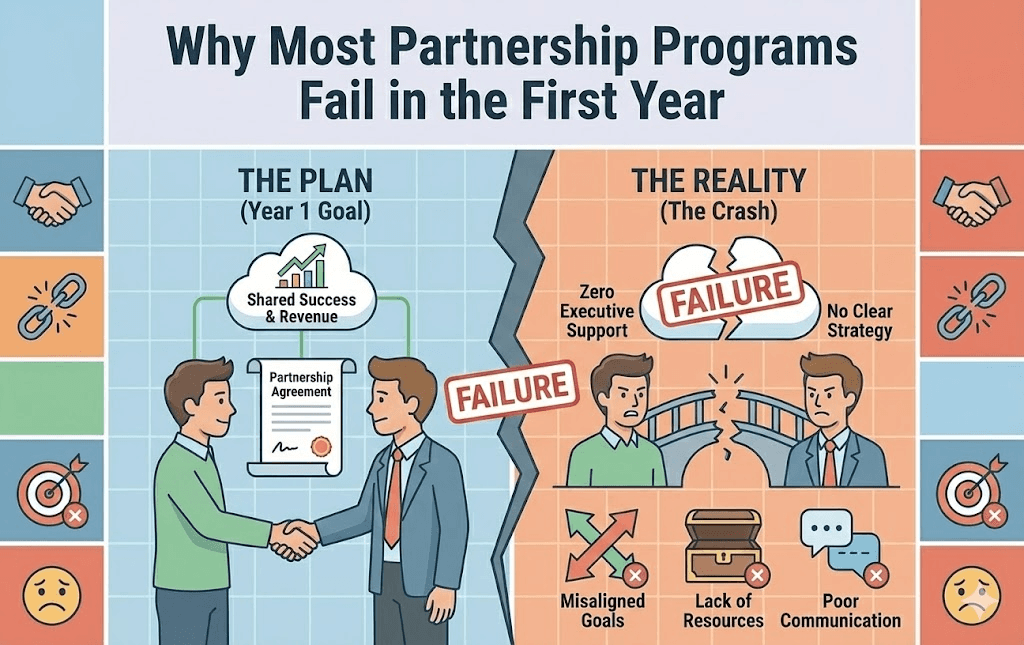
Why Most Partnership Programs Fail in the First Year
Date
Nov 11, 2025
Author
Matt Astarita
The "Partnership Dream" is seductive.
A Founder or VP of Sales looks at the success of companies like HubSpot, Salesforce, or Shopify, and thinks: "If we build a partner program, other companies will sell our product for us. It’s free revenue!"
So, they hire a "Head of Partnerships." They buy a PRM (Partner Relationship Management) tool. They announce the program on LinkedIn.
Twelve months later? The program is quietly shut down, the Head of Partnerships is let go, and the CEO says, "Partnerships just don't work for our industry."
But the industry wasn't the problem. The execution was.
Building an ecosystem is a long-term play, but most companies try to run it with a short-term playbook. Here are the three silent killers of early-stage partner programs in 2026.
Jump to a section:
The "Sales Rep" Fallacy
Product-Market Fit (PMF) before Partner-Market Fit
The "Give-Get" Imbalance
How to Survive Year One
1. The "Sales Rep" Fallacy
The Mistake: Treating partners like unpaid sales reps.
Many companies launch a program with the expectation that partners will immediately start bringing them leads. They send out commission agreements and sit back, waiting for the deal registration alerts.
The Reality: Partners are not your employees. They have their own quotas, their own roadmaps, and their own fires to put out. They do not wake up thinking about how to sell your product.
If your entire strategy is "Here is a 20% referral fee, go sell," you will fail. In 2026, commissions are table stakes, not motivators. Partners need enablement, not just incentives. They need you to spoon-feed them the value proposition so clearly that referring you makes them look good to their clients.
⚡ Pro-tip: Don't ask, "How can you sell for me?" Ask, "How can I help you close your deals faster?"
2. Product-Market Fit before Partner-Market Fit
The Mistake: Scaling partnerships before the product is ready.
There is a dangerous trend of early-stage startups trying to use partnerships to "find" their market. This is backward. You cannot outsource your product-market fit discovery.
If your direct sales team struggles to close deals, your partners will struggle ten times more. A partner is a force multiplier. If you multiply zero, you get zero.
The Reality: Your partner program should only launch after you have a repeatable sales motion. You need to hand your partners a "Playbook that Wins," not a "Playbook that Experiments."
3. The "Give-Get" Imbalance
The Mistake: asking for the "Get" before the "Give."
Most year-one programs are extractionary. They ask for leads, data, and intros immediately. They treat the ecosystem like an ATM.
The Reality: Trust is the currency of Ecosystem-Led Growth. You have to make a deposit before you can make a withdrawal.
The most successful programs in 2026 start with a "Give First" mentality:
Co-Marketing: "We will feature you to our 10k newsletter subscribers."
Intel: "We mapped our accounts and found 50 mutual prospects, here is the list."
Product: "We built an integration that fixes a churn risk for your users."
If you lead with value, the leads will follow. If you lead with a greedy hand, the door will close.
4. How to Survive Year One
If you want to avoid the graveyard of failed programs, change your Year One KPIs.
Stop measuring "Revenue" in Q1 and Q2. Start measuring "Signal" and "Trust."
Focus on "Early Wins": Find 3 partners and get them one win each. Manually. Do the work for them. These success stories become your case studies to recruit the next 30.
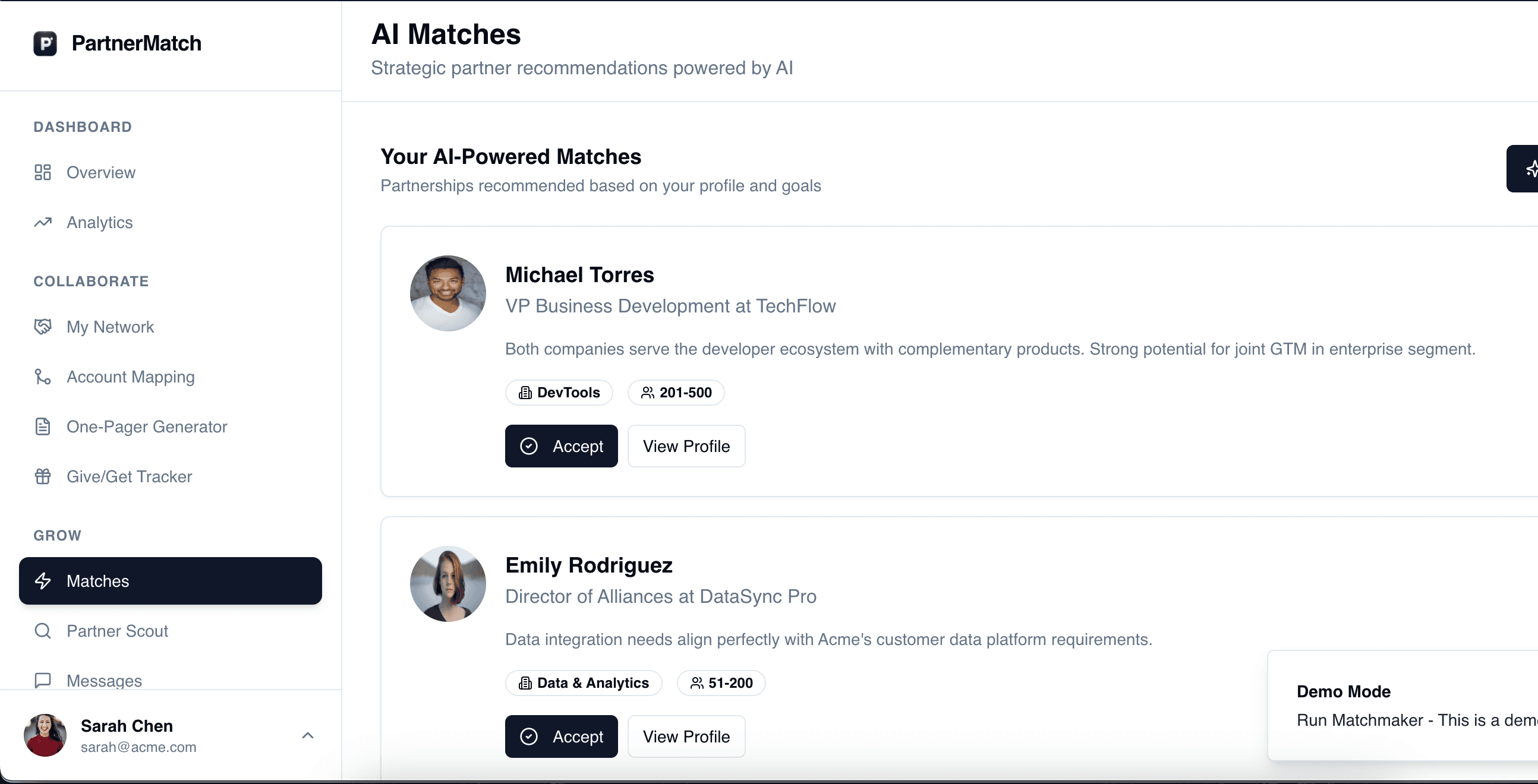
Use Intent Data: Don't waste your limited runway chasing cold partners. Use PartnerMatchcoi to identify companies that are actively signaling Strategic Intent (e.g., "Looking for Tech Partners").
The Verdict: Partnerships are a flywheel. They are heavy and hard to push at the start. But if you push correctly by adding value, respecting your partners' time, and targeting the right intent, once that wheel starts spinning, it becomes unstoppable.
Don't build a "Program." Build a Relationship Engine.