Product Leaders
Why Developers are the New Kingmakers in B2B Partnerships
Date
Nov 15, 2025
Author
Matt Astarita
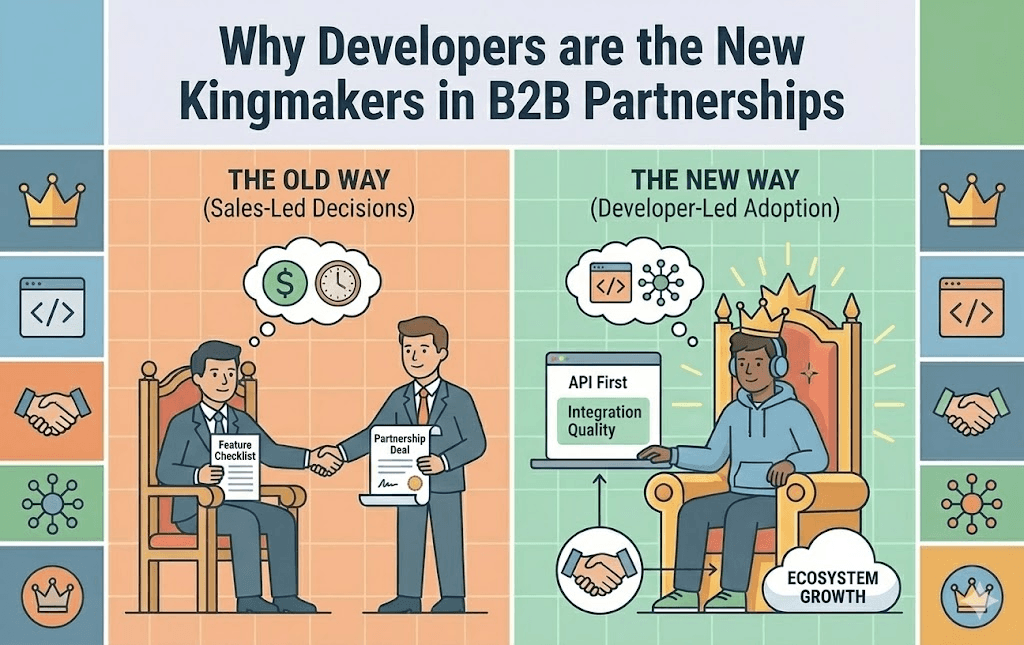
In the boardroom of 2015, the sales process was a top-down affair. You took the CIO to a steak dinner, promised them "Digital Transformation," and waited for the contract to be signed. The people actually using the software were an afterthought.
In 2026, that playbook is extinct.
Today, the most powerful person in the buying committee isn't the one with the biggest budget. It is the one with the GitHub commit access.
We are witnessing the era of the Developer Kingmaker. Even if they don't sign the final check, they hold the veto power. If a Lead Developer looks at your integration and says, "This API is trash," the deal dies instantly. No amount of steak dinners can fix bad code.
Here is why the technical team has seized the throne, and how you need to change your partnership strategy to bow to the new royalty.
The Shift: From "Shadow IT" to "Product-Led Selection"
Ten years ago, when developers spun up their own servers or used unauthorized tools, it was called "Shadow IT." It was a problem to be solved.
Today, it is the standard procurement model.
The Motion: A developer encounters a problem. They search Google for a solution. They sign up for a free tier. They test the API.
The Result: By the time the VP of Engineering hears about it, the tool is already embedded in the production stack.
The "Partnership" wasn't formed in a meeting room. It was formed in a command line interface (CLI).
[Internal Link Opportunity]: Link this section to Article #31: "Why Ecosystem-Led Growth is the New PLG" to connect developer adoption with the broader PLG trend.
The "Veto" Power of the Technical Lead
You might think you are selling to the Head of Partnerships, but you are actually selling to their technical gatekeeper.
Imagine this scenario:
Sales Match: Your VP of Sales and their VP of Sales agree to partner.
Product Review: The request goes to the Product/Engineering team for implementation.
The Code Audit: Their Senior Engineer spends 15 minutes on your docs.
If that engineer reports back: "Their documentation is confusing, they don't use standard auth, and the SDK is broken," the VP of Product will kill the project to protect their roadmap.
The Reality: The Developer didn't pick the partner, but they disqualified the partner. In 2026, you cannot win without the Kingmaker's blessing.
How to Win the Kingmaker (The DX Strategy)
Developers are immune to traditional marketing. They hate buzzwords. They hate "Calls to Talk." They hate friction.
To win them over, you need to invest in DX (Developer Experience).
Feature
| What Sales Wants
| What Developers Want
|
Asset
| A glossy PDF One-Pager.
| A Copy-Paste code snippet.
|
Access
| "Request a Demo" form.
| Instant API Key generation.
|
Support
| A dedicated Account Manager.
| A public Discord/Slack community.
|
Proof
| Gartner Magic Quadrant.
| 5,000 Stars on GitHub.
|
If you want to build a partnership with a tech company, your "Pitch Deck" should be a Repo.
Send them a link to a working prototype on GitHub that uses their tool. That speaks louder than any slide.
[Internal Link Opportunity]: Link this section to Article #45: "API Documentation as a Marketing Tool" to reinforce that docs are your primary sales asset for this persona.
The "Trojan Horse" of Open Source
The smartest partnership strategy in 2026 is often Open Source.
If you build an open-source adapter or SDK that solves a specific pain point for their developers, you bypass the commercial gatekeepers entirely.
Strategy: "We built an open-source Python library for connecting [Your Tool] to [Their Tool]."
Outcome: Their developers start using it because it saves them time. Once it becomes a dependency, the commercial partnership is inevitable.
The Verdict for 2026
Stop treating the technical team like "Implementation Resources." Treat them like customers.
If you make a developer look like a hero by saving them time, reducing their bugs, or making them look smart—they will carry your flag into the boardroom for you.
You don't need to convince the C-Suite. You just need to convince the person who writes the code.