Industry Guides
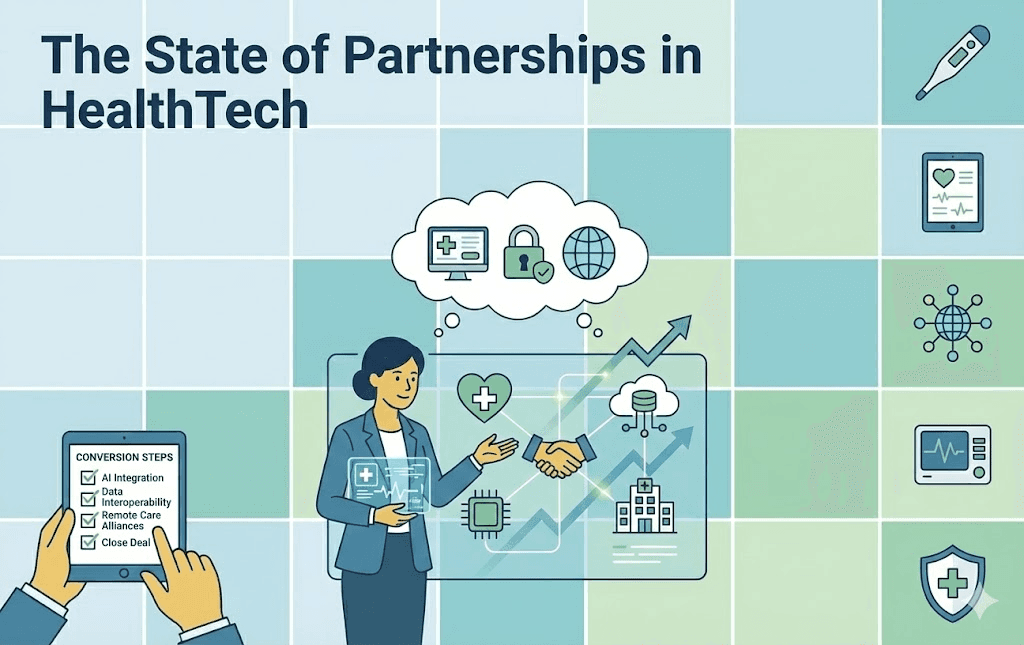
The State of Partnerships in HealthTech
Date
Sep 17, 2025
Author
Matt Astarita
Struggling to integrate with Epic or Cerner? Let's clear the air. In HealthTech, "Speed" is a dirty word. The average sales cycle is 18 months, and the average integration takes 9 months.
In 2026, the HealthTech ecosystem is defined by one word: Interoperability.
The "Walled Gardens" of the past (where EMRs blocked data sharing) have finally crumbled under regulatory pressure (TEFCA and FHIR standards). The data is flowing, but the pipes are messy.
If you are building a HealthTech product, you cannot survive as a standalone "Point Solution." Doctors are drowning in apps. They don't want another login; they want a workflow.
Here is how to navigate the complex, regulated world of healthcare alliances.
The "Pilot" Trap (and How to Avoid It)
Health systems love "Pilots." They will happily pay you $20k to run a test in one hospital ward for a year. This is the valley of death.
Most pilots never convert to enterprise contracts. They are "Innovation Theater" for the hospital's marketing team.
The Fix: Partner with the Payer (Insurance), not just the Provider (Hospital).
Provider Incentive: "This tool saves my doctors time." (Soft ROI).
Payer Incentive: "This tool prevents readmissions and saves me $50M." (Hard ROI).
In 2026, the smartest HealthTechs are partnering with Value-Based Care (VBC) Organizations, entities that are paid to keep people healthy, not just to treat them when they are sick.
The "EMR App Store" Strategy
You cannot sell to a doctor if you are not inside their Electronic Medical Record (EMR) system (Epic, Oracle/Cerner, Athenahealth).
But direct integration is expensive ($50k+). The Shortcut: Partner with Middleware Aggregators. Companies like Redox or Particle Health have already built the pipes.
Strategy: Do not build a custom Epic integration. Build a single connection to Redox.
Benefit: You instantly unlock compatibility with 5,000+ hospitals.
[Internal Link Opportunity]: Link this section to Article #41: "Build vs. Partner" to validate the decision to buy middleware rather than building custom HL7 feeds.
The "RPM" Boom (Remote Patient Monitoring)
The biggest growth area in 2026 is Hospital-at-Home. Patients are being discharged earlier, equipped with sensors (Apple Watch, Oura, custom devices).
The Partnership: Hardware + Software + Service.
Hardware Partner: Provides the device (e.g., Withings).
Software Partner: Ingests the data (You).
Service Partner: Nurses who monitor the dashboard (e.g., a Clinical Call Center).
If you are a software company, find a Clinical Service Partner. Hospitals don't want software alerts; they want a nurse to call the patient when the alert goes off. If you don't offer the service, partner with someone who does.
[Internal Link Opportunity]: Link this section to Article #2: "The 'Whole Product' Problem" to explain why software alone isn't enough in healthcare.
Navigating HIPAA and "BAAs"
In other industries, you sign an NDA. In HealthTech, you sign a Business Associate Agreement (BAA).
This is the legal contract that makes you liable for patient data. The Partnership Blocker: Many tech companies are terrified of signing BAAs.
The Edge: If you are "HIPAA Native," market it.
Pitch: "We are SOC2 and HIPAA compliant, and we have a standard BAA ready to sign today."
This reduces the legal review cycle from 6 months to 6 weeks.
[Internal Link Opportunity]: Link this section to Article #47: "Assessing Technical Compatibility" to include compliance readiness.
The Rise of "FemTech" and Niche Ecosystems
The "General Health" market is saturated. The "Niche Health" market is booming.
Mental Health
Fertility / Women's Health
Musculoskeletal (MSK)
The Cross-Sell Opportunity: These point solutions are banding together to form "Virtual Clinics."
Example: A Mental Health app partners with a Sleep Tracking app.
Logic: Poor sleep causes anxiety. They share the patient (with consent) to treat the whole person.
Use PartnerMatch.co to find non-competitive health apps that treat the causes or symptoms of the condition your app manages.
The Verdict for 2026
HealthTech partnerships are not about "leads." They are about Clinical Outcomes.
If you can prove that your partnership reduces the cost of care or improves patient survival, the money will follow. But remember: In healthcare, trust is binary. One data breach kills the company. Partner carefully.