Founders & CEOs
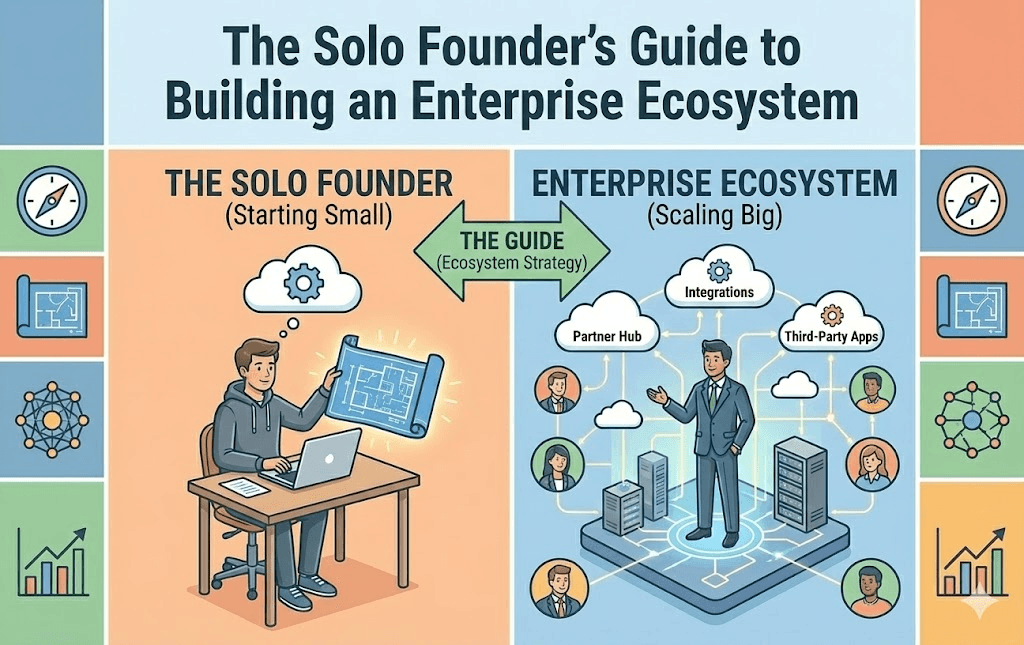
The Solo Founder’s Guide to Building an Enterprise Ecosystem
Date
Nov 24, 2025
Author
Matt Astarita
There is a pervasive myth in Silicon Valley that to sell to the Enterprise, you must be an Enterprise.
You supposedly need 500 employees, a glass office in San Francisco, and a fleet of salespeople in Patagonia vests.
In 2026, this myth is dead.
We are seeing the rise of the "Micro-Unicorn" companies with fewer than 10 employees generating $10M+ in ARR. How do they do it? They don't build infrastructure; they orchestrate ecosystems.
As a Solo Founder, you have one massive advantage over the giants: Speed. You can build the "glue" that connects the giants faster than they can connect themselves.
Here is the blueprint for how a one-person team can leverage an ecosystem to close Fortune 500 deals.
Jump to a section:
The "Middleware" Strategy (Be the Glue)
Outsourcing the "Suit & Tie" (Service Partners)
The "Trust Proxy" (Compliance as Marketing)
Automating the Relationship Layer
1. The "Middleware" Strategy (Be the Glue)
Enterprises are islands. They have a massive ERP (like SAP) and a massive CRM (like Salesforce), and those two systems hate each other.
The giants move too slowly to build deep, niche connectors. This is your wedge.
The Strategy: Don't try to replace the ERP. Connect it. Build a product that does one thing extremely well (e.g., "Syncing SAP Inventory to Shopify Real-Time").
Why it works for Solo Founders: The scope is narrow. You don't need a 50-person engineering team to maintain it.
The Leverage: Once you are installed as the "connector," both SAP and Shopify have a vested interest in selling you. You become the critical infrastructure without the infrastructure costs.
[Internal Link Opportunity]: Link this section to Article #29: "How to Pitch Your Product to a Potential Integration Partner" to see how to pitch this "Gap & Plug" value prop.
2. Outsourcing the "Suit & Tie" (Service Partners)
Here is the problem: Enterprises want "White Glove Onboarding." They want a dedicated Account Manager, weekly training sessions, and custom implementation. As a Solo Founder, you don't have time for that.
The Fix: Partner with Boutique Consultancies.
Find the small, 5-10 person consulting firms that specialize in the platform you integrate with.
The Deal: "I will give you this software. You sell the implementation package. You keep 100% of the service revenue."
They become your "Enterprise Success Team." They wear the suits. They hold the client's hand. You stay focused on the code. To the client, it looks like a seamless delivery. In reality, it’s a symbiotic partnership.
[Internal Link Opportunity]: Link this section to Article #32: "How to Scale Distribution Without Hiring a Sales Team" to reinforce the Service-Attach Leverage model.
3. The "Trust Proxy" (Compliance as Marketing)
You might be one person in a garage (or a WeWork), but you cannot look like one. Enterprises buy safety.
If you don't have a brand name, you must borrow one. In 2026, Compliance is the new Marketing.
Get SOC2 Type II: It costs money ($15k-$20k), but it is cheaper than hiring a sales VP. It is the passport to the Enterprise.
Get Listed in Cloud Marketplaces: If an Enterprise buys you through the AWS Marketplace, they aren't vetting you financially; they are transacting with AWS. You borrow Amazon's billing trust.
[Internal Link Opportunity]: Link this section to Article #20: "The Universal API for Business Trust" to explain how standardized trust signals replace the need for a big brand.
4. Automating the Relationship Layer
How do you manage 20 agency partners and 5 tech platforms by yourself? You cannot do coffee chats.
You need an Automated Partner Ops stack.
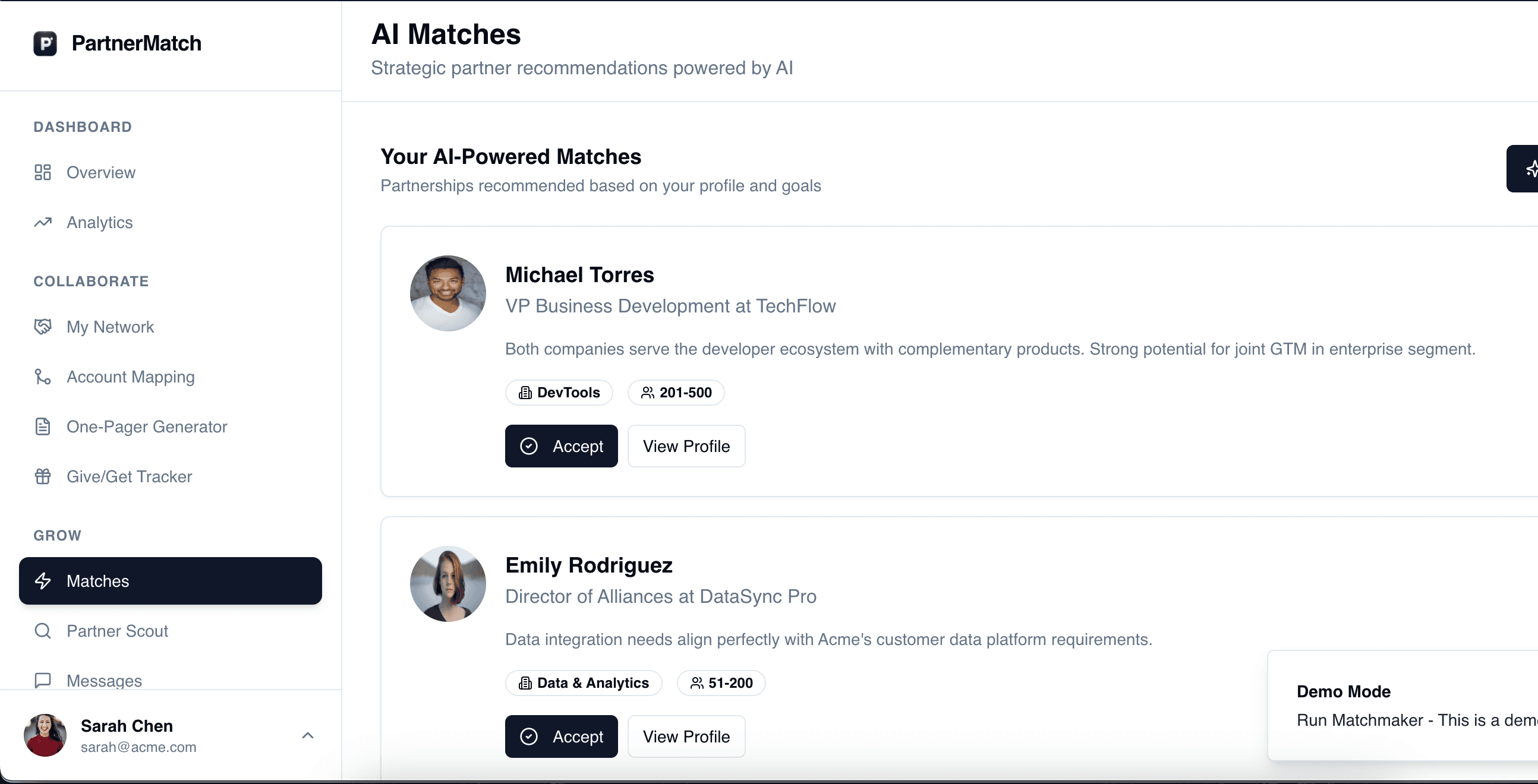
Recruitment: Use PartnerMatch.co to find partners who match your Intent (e.g., "Boutique Consultancies in Retail").
Onboarding: Record a Loom video series. Do not do live trainings.
Updates: Use AI to scrape your changelog and email partners a "What's New" summary every month.
The Goal: You should only talk to a partner when money is changing hands. Everything else must be asynchronous.
The Verdict
Being small is a feature, not a bug. It forces focus.
By building an ecosystem of Service Partners (who do the people work) and Tech Partners (who do the distribution work), a Solo Founder can sit in the middle and collect the toll.
You don't need to be the Empire. You just need to supply the roads.