Relationship Building
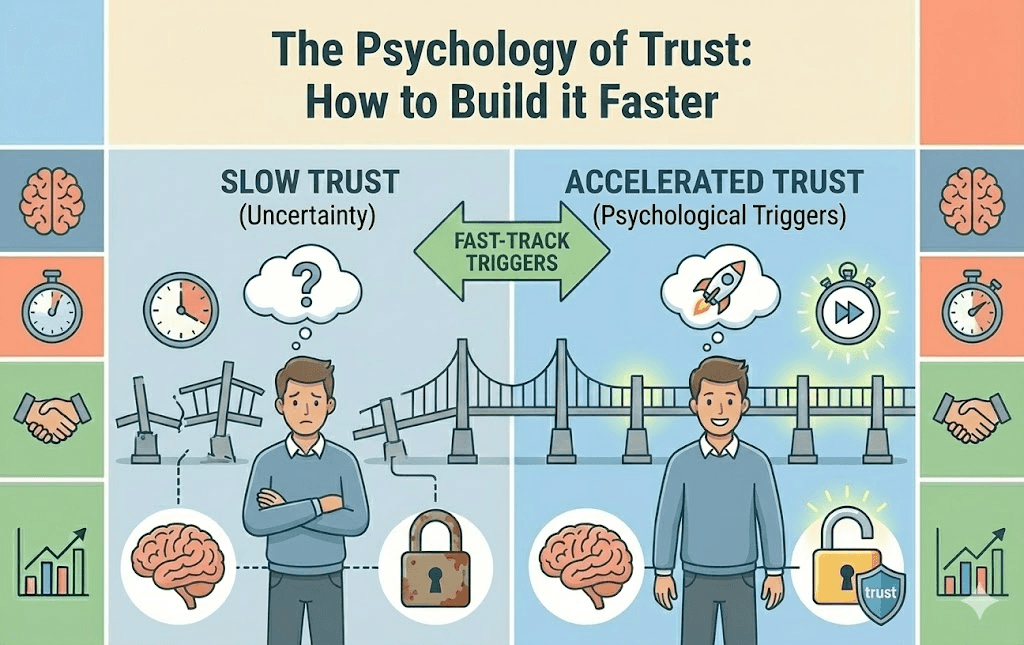
The Psychology of Trust: How to Build it Faster
Date
Nov 28, 2025
Author
Matt Astarita
Struggling to close deals because the other side is "risk-averse"? Let's clear the air. "Risk-averse" is just a polite way of saying they don't trust you yet.
The old adage says: "Trust takes years to build and seconds to break."
In 2026, this is a lie. You don't have years. You have a 30-minute Zoom call.
If you believe trust is a slow, organic process, you will lose to competitors who know how to engineer it. Trust is not magic; it is a mechanism. It is a psychological calculation that the human brain runs to answer one question: "Is this person safe?"
Here is the formula for Swift Trust, how to hack the calculation and get to "Yes" in record time.
The Trust Equation (The Math)
David Maister’s Trust Equation is the governing law of professional relationships. If you want to build trust faster, you must optimize the variables.
$$Trust = \frac{Credibility + Reliability + Intimacy}{SelfOrientation}$$
Most people focus on the Numerator (trying to look smart).
The Hack: The fastest way to increase the score is to lower the Denominator (Self-Orientation).
Credibility: "I know my stuff." (Status).
Reliability: "I do what I say." (Consistency).
Intimacy: "I understand your pain." (Empathy).
Self-Orientation: "I care about my commission more than your success." (The Killer).
If you smell like a "Taker," your Self-Orientation is High, and your Trust Score drops to zero—no matter how smart (Credible) you are.
The "Vulnerability Loop" (The Shortcut)
We are trained to be "Professional." We wear a mask of perfection.
This kills trust. Perfection is suspicious. Humans trust other humans who have flaws.
The Strategy: Trigger a Vulnerability Loop early.
The Old Way: "We are the market leader with zero downtime and perfect support." (They know you are lying).
The Trust Way: "Honestly, our reporting dashboard is a bit clunky right now. We are fixing it in Q4. But our data accuracy is the best in the world."
Why this works:
By admitting a weakness (Strategic Vulnerability), you prove that you are honest.
When you subsequently claim a strength ("Data accuracy is best"), they believe you because you didn't lie about the weakness.
[Internal Link Opportunity]: Link this section to Article #50: "Why Transparency is Your Best Sales Tool" to reinforce the power of honesty.
The "Say-Do" Ratio (Micro-Commitments)
Trust is predictive. I trust you if I can predict your future actions.
You can build a track record of prediction in 24 hours using Micro-Commitments.
The Protocol:
In the meeting: Make a small, specific promise. "I will send you that PDF by 5:00 PM today."
The Execution: Send it at 4:45 PM.
Do this three times in a row with trivial tasks.
"I'll intro you to Dave." (Done).
"I'll fix that typo." (Done).
By the time you ask for the $100k contract, their brain has already categorized you as: "Person who does what they say."
If you send the PDF at 9:00 AM the next day, you have technically "delivered," but you have failed the prediction test.
The "Anti-Sales" Pitch (Disqualification)
Nothing builds trust faster than telling someone not to buy your product.
The Scenario:
You are on a call. You realize they aren't a great fit.
The Salesman: Tries to shoehorn them in to hit quota. (High Self-Orientation).
The Trusted Advisor: "Listen, based on what you said, we are overkill for you. You should actually use [Competitor X]. They are cheaper and better for your stage."
The Result:
They will be shocked. You just lost a deal, but you gained a disciple.
Six months later, when they are ready, or when a friend asks for a recommendation, they will send them to you. Why? Because you proved you care about their outcome more than your wallet.
[Internal Link Opportunity]: Link this section to Article #24: "How to Spot a Time-Waster" to show how this also saves your time.
The "Borrowed Trust" (Social Proof)
If you are a stranger, you start at Trust Level 0.
If you come via a Warm Intro, you start at Trust Level 7.
Trust is transitive. If A trusts B, and B trusts C, then A trusts C.
The Tactic:
Before the call, find the mutual connection on LinkedIn.
Opener: "I saw you worked with Sarah at Acme Corp. We did a big project with her last year."
You are "Drafting" behind Sarah's reputation. Do not try to generate trust from scratch when you can import it.
[Internal Link Opportunity]: Link this section to Article #72: "The Etiquette of the Warm Intro" to execute this correctly.
The Verdict for 2026
Speed is a function of friction. Lack of trust is the ultimate friction.
If you want to move fast:
Lower your Self-Orientation.
Admit a flaw.
Keep micro-promises.
Stop trying to "Sell." Start trying to "Help." The irony is, you will sell a lot more.