Future Trends
Scaling Trust: Can Algorithms Actually Build Relationships?
Date
Nov 22, 2025
Author
Matt Astarita
"Business is all about relationships."
It is the oldest cliché in the book. And for a long time, it was true. You did business with people you liked, people you knew, people you trusted.
But there is a biological limit to this strategy. It’s called Dunbar’s Number.
According to anthropologist Robin Dunbar, a human can only maintain about 150 stable relationships. Beyond that, our brains max out. We forget names, we forget promises, and the connection degrades into a "acquaintance."
Here lies the paradox of the modern Partnership Manager:
The Goal: Build an ecosystem of 1,000+ partners.
The Reality: Your brain can only handle 150.
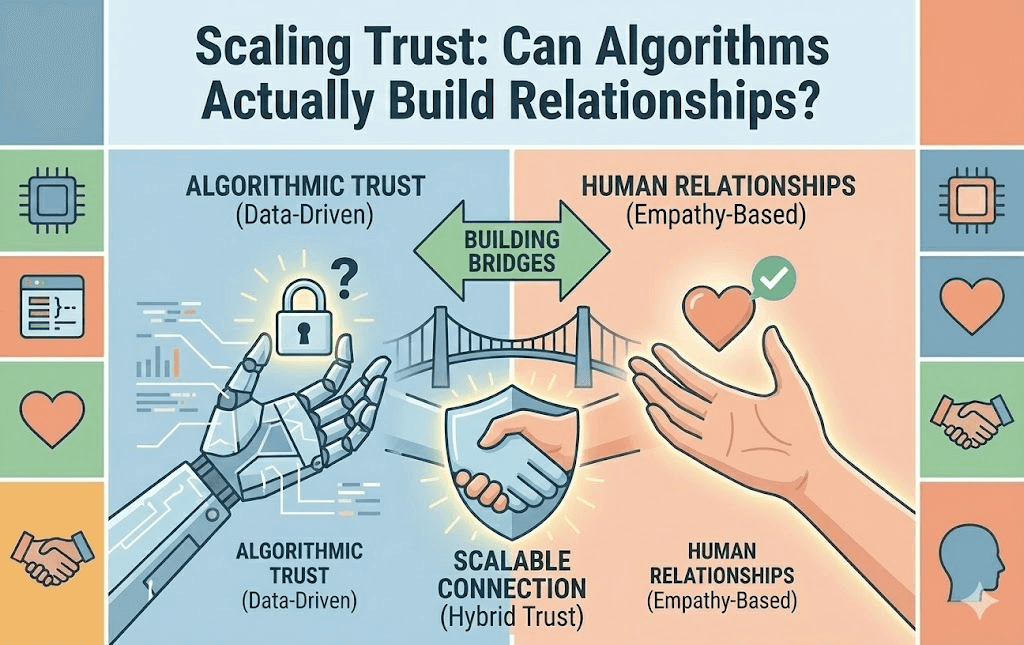
So, how do you bridge the gap between the 150 you can know and the 1,000 you need to manage? You don't try to scale yourself. You scale trust using algorithms.
Jump to a section:
The Formula for Trust (It’s Not Magic)
Automated Reliability > Human Flakiness
The "Cyborg" Approach to Relationship Building
1. The Formula for Trust (It’s Not Magic)
We tend to think of trust as a fuzzy, magical feeling. But in B2B, trust is actually a mathematical formula:
$$Trust = (Credibility + Reliability + Intimacy) / Self-Orientation$$
Credibility: Do you know your stuff?
Reliability: Do you do what you say?
Intimacy: Do I feel safe with you?
Self-Orientation: Do you care about me, or just yourself?
Humans are great at Intimacy. We are terrible at Reliability at scale.
We forget to follow up. We miss emails. We drop the ball.
[Internal Link Opportunity]: Link this section to Article #2: "The Coffee Chat Trap" to explain how focusing only on intimacy (coffee chats) without reliability kills productivity.
Algorithms are the opposite. They have zero Intimacy, but they have 100% Reliability. An algorithm never "forgets" to send the Q2 performance report. It never "gets too busy" to check in.
2. Automated Reliability > Human Flakiness
Here is a hard truth for 2026: A partner would rather deal with a reliable bot than a flaky human.
If you promise to send me a referral every month, and you forget three months in a row, I don't trust you, even if we had a great lunch.
If an AI agent automatically routes me a relevant referral every single Tuesday like clockwork, I trust that system implicitly.
AI builds trust through consistency.
The Check-In: AI can analyze a partner’s news feed and prompt you: "Partner X just won an award. Send a Congrats note."
The Value Add: AI can automatically scan your customer base and email a partner: "We just identified 5 new mutual customers. Here is the list."
You get the credit for being attentive, but the algorithm did the heavy lifting.
[Internal Link Opportunity]: Link this section to Article #16: "Will AI Replace Partnership Managers?" to reinforce that AI handles the consistency while you handle the strategy.
3. The "Cyborg" Approach to Relationship Building
So, can an algorithm fully replace the relationship? No.
If a crisis happens—a data breach, a contract dispute, a missed commission—you cannot send a bot. That is when you need Relational Capital.
The best strategy for 2026 is the "Cyborg" approach:
Let AI handle the "Maintenance Trust": The updates, the reports, the scheduling, the data sharing.
You handle the "Critical Trust": The negotiation, the conflict resolution, the visionary planning.
This allows you to "hack" Dunbar’s Number. You can technically manage 1,000 partners because the AI is maintaining the baseline relationship with 950 of them, leaving you free to focus your human energy on the top 50.
The Verdict
Don't be afraid to let a machine manage your relationships.
In a world of noise, the most "human" thing you can do is be reliable. And if an algorithm helps you keep your promises, then the algorithm is the best friend your partners have.