Metrics, Data & Attribution
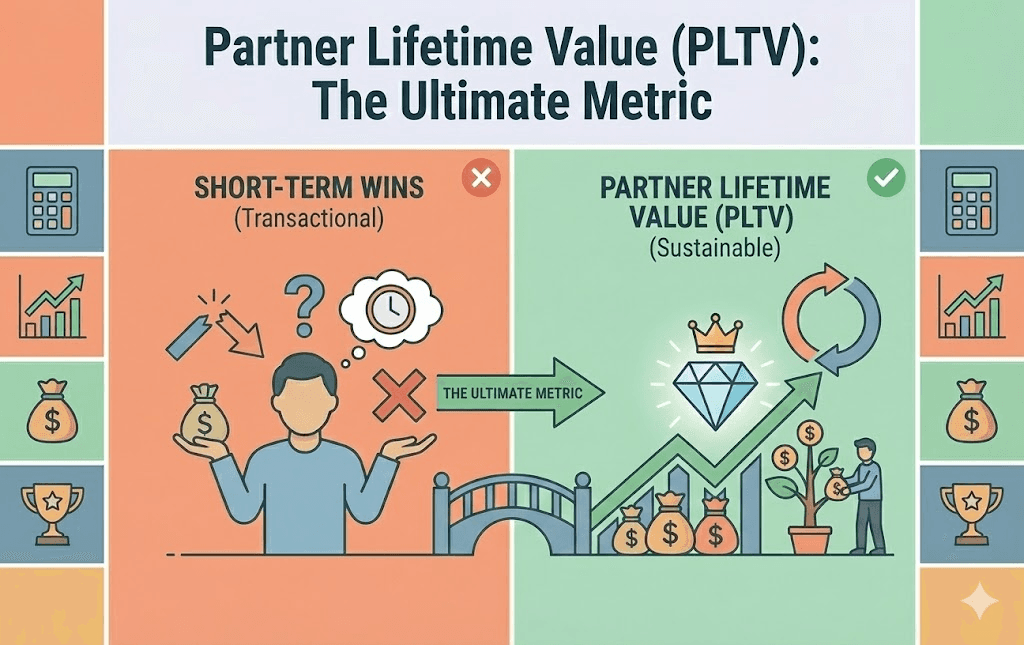
Partner Lifetime Value (PLTV): The Ultimate Metric
Date
Nov 19, 2025
Author
Matt Astarita
Struggling to justify the cost of your "Partner Enablement" team? Let's clear the air. Your CEO asks: "Why are we spending $5,000 flying this partner to our HQ when they only sold $2,000 this year?"
If you look at Year 1 alone, you are failing.
Partnerships are a J-Curve investment. You lose money early to make exponential returns later.
In 2026, the most sophisticated ecosystem leaders do not track "Number of Partners." They track PLTV (Partner Lifetime Value).
They treat their ecosystem like a Venture Capital portfolio. Some assets are winners, some are losers, and the math decides which ones get funding.
Here is how to calculate PLTV and use it to make ruthless resource allocation decisions.
The Formula
PLTV is the total net profit you expect to generate from a single partner over the entire duration of the relationship.
$$PLTV = (Avg\ Annual\ Revenue \times Gross\ Margin \times Retention\ Years) - (CAC + Support\ Costs)$$
Avg Annual Revenue: The Sourced + Influenced revenue they bring.
Gross Margin: Your software margin (usually 80-90%).
Retention Years: How long they stay active (usually 3-5 years).
CAC: Cost to Recruit (Ads, Events, Headcount).
Support Costs: The cost of the Partner Manager and Tech Support tickets.
The Insight:
If a partner brings $10k/year but costs $5k/year to support and churns in Year 2, their PLTV is barely positive. They are a distraction.
If a partner brings $50k/year and stays for 5 years, their PLTV is $200k+. They are an Asset.
The J-Curve (The "Valley of Death")
You must educate your CFO on the J-Curve.
Year 0-1 (The Investment Phase):
You spend money recruiting, training, and certifying them.
Revenue: $0 - $10k.
ROI: Negative.
Year 2 (The Ramp):
They know the product. They start attaching it to deals.
Revenue: $50k.
ROI: Breakeven.
Year 3+ (The Harvest):
They are autonomous. They sell without your help.
Revenue: $100k+.
ROI: Exponential.
The Strategy:
If you fire a partner in Year 1 because "they aren't selling enough," you just realized the loss without waiting for the gain. You must optimize for Retention to cross the "Valley of Death."
[Internal Link Opportunity]: Link this section to Article #86: "Benchmarking Your Program" to set expectations for Year 1 activation.
Segmentation by PLTV (Kill or Invest)
Once you calculate PLTV, you realize you cannot treat all partners equally. You must segment your service levels based on Future Value, not just Current Revenue.
Segment
| PLTV Estimate
| The Strategy
|
The Whales (GSIs)
| $1M+
| Concierge Service. Weekly calls, dedicated engineer, executive dinners.
|
The Performers (Agencies)
| $100k - $500k
| Managed Service. Monthly calls, dedicated Partner Manager.
|
The Long Tail (Affiliates)
| < $10k
| Self-Service Only. Portal, automated emails, community support. No humans.
|
The Mistake:
Most programs let "$10k PLTV" partners consume the time of a "$150k Salary" Partner Manager. This destroys your unit economics.
If the PLTV is low, the cost to serve must be zero (Automation).
Calculating "Allowable CAC"
Knowing your PLTV tells you exactly how much you can spend to acquire a new partner.
The Golden Ratio for SaaS is 3:1 (LTV:CAC).
If your average Partner PLTV is $90,000.
You can afford to spend $30,000 to recruit one qualified partner.
The Action:
This unlocks your marketing budget.
"CFO, I need $20k to sponsor this Agency Conference. We expect to sign 2 partners. Since our PLTV is $90k, the ROI is 9x. Here is the math."
Suddenly, the budget gets approved.
[Internal Link Opportunity]: Link this section to Article #81: "The Only 3 KPIs Your CFO Cares About" to tie this back to Capital Efficiency.
The "Referral" Multiplier (Network Effects)
True PLTV includes Second-Order Effects.
Great partners recruit other partners.
Scenario: A top HubSpot Agency tells two other agencies to join your program.
The Math: You attribute a portion of the new partners' PLTV back to the original referrer.
This is why "Community Leaders" often have the highest PLTV, even if they don't resell much software themselves. Their Influence Value is massive.
The Verdict for 2026
Stop counting logos. A list of 1,000 inactive partners is a liability, not an asset.
A list of 50 high-PLTV partners is a money-printing machine.
Run the math. Fire the bottom 20% who cost more than they deliver. Double down on the assets that compound.