Founders & CEOs
How to Scale Distribution Without Hiring a Sales Team
Date
Sep 14, 2025
Author
Matt Astarita
The classic "Silicon Valley Playbook" from 2015 to 2022 was predictable:
Raise VC money.
Hire a VP of Sales.
Hire 20 Account Executives (AEs) and 10 SDRs.
Burn cash until you (hopefully) hit escape velocity.
In 2026, this playbook is broken.
Capital is expensive. Customer Acquisition Cost (CAC) on outbound channels has skyrocketed. And worst of all, buyers have stopped answering the phone. Buyers today prefer to buy through trusted intermediaries rather than direct from a cold caller.
The most efficient companies today are not building massive sales armies. They are building Distribution Protocols. They are leveraging other people's sales teams to carry their bag.
Here is the CEO’s guide to decoupling revenue growth from headcount growth.
Jump to a section:
The Unit Economics: Fixed vs. Variable Scale
Strategy A: The "Cloud Marketplace" Slipstream
Strategy B: The Service-Attach Leverage
Strategy C: The "Embedded" Play (Whitelabeling)
How to Operate This Model (The Team You Actually Need)
1. The Unit Economics: Fixed vs. Variable Scale
Before we discuss tactics, we must look at the P&L.
When you hire a Sales Team, you are taking on Fixed Risk.
Cost: Salaries, Benefits, Tech Stack (Salesforce, Gong, Outreach), Recruiting Fees.
Risk: If they don't hit quota, you still pay them. You burn cash.
Scaling: Linear. To double revenue, you generally have to double the team.
When you use an Ecosystem Strategy, you are shifting to Variable Cost.
Cost: Revenue Share (20-30%) or Wholesale Discounts.
Risk: Zero. If they don't sell, you don't pay.
Scaling: Geometric. One partner manager can manage 50 partners, who in turn might have 500 sales reps total.
The 2026 Founder Mindset: Would you rather keep 100% of a deal that cost you $50,000 in CAC and salaries to close? Or keep 70% of a deal that cost you $0 to close?
Smart CEOs choose the latter. It is non-dilutive capital.
[Internal Link Opportunity]: Link this section to Article #31: "Why Ecosystem-Led Growth is the New PLG" to reinforce the efficiency argument.
2. Strategy A: The "Cloud Marketplace" Slipstream
The biggest "Sales Teams" in the world belong to Amazon (AWS), Microsoft (Azure), and Google (GCP).
In 2026, the Cloud Marketplaces are the new B2B App Stores. But simply "listing" there isn't the strategy. The strategy is tapping into the EDP (Enterprise Discount Program).
How it works: Large enterprises commit to spending millions (e.g., $10M/year) with AWS to get discounts. If they don't spend it, they lose it. If your software is transactable on the AWS Marketplace, a buyer can purchase your tool using their committed AWS budget.
Why this replaces your sales team:
Budget Access: You aren't fighting for a new budget line item; you are eating from a pre-approved bucket.
Procurement Speed: Instead of a 6-month legal review, you ride on the existing AWS contract.
The Co-Sell: AWS sales reps are incentivized to sell your product because it burns down their client's commitment.
Action: Don't hire a Sales Rep. Hire a Cloud Alliance Manager whose only job is to be best friends with AWS/Azure reps.
3. Strategy B: The Service-Attach Leverage
This is the most underutilized lever for SaaS founders.
The Premise: Agencies, System Integrators (SIs), and Consultants sell Services (Time). They are constantly looking for software that creates more service work for them.
If your product is "Plug and Play," agencies don't care. But if your product is a "Platform" that requires setup, strategy, and management, agencies will sell it for you aggressively.
The Math:
You sell a $20k license.
The Agency sells a $50k implementation + $5k/month retainer to run it.
The Agency will fight to get you into the deal because your $20k tool unlocks their $100k contract. Their sales team becomes your sales team.
Action: Identify the Service Providers in your niche. Pitch them on the Service Revenue potential, not the software features.
Script: "For every $1 of my software you sell, you can bill $3 in services."
[Internal Link Opportunity]: Link this section to Article #28: "Resellers vs. Referral Partners" to help decide if you need a referral or reseller model here.
4. Strategy C: The "Embedded" Play (Whitelabeling)
This is the "Nuclear Option" for distribution.
Instead of selling your tool to the end user, you sell it to a larger software platform to embed as a native feature.
Example: You build an "Expense Management" tool.
Direct Route: You hire 50 reps to call CFOs. (Hard).
Embedded Route: You partner with a "Neo-Bank" or a "Payroll Provider" (like Gusto or Rippling). They embed your tool into their dashboard as "Gusto Expenses, powered by [You]."
The Impact: You sign one partnership deal, and suddenly you are distributed to 500,000 businesses overnight. You have zero CAC on those users.
The Trade-off: You lose brand visibility. You are the "Intel Inside." But for a CEO focused on cash flow and market share, this is often a worthy trade.
[Internal Link Opportunity]: Link this section to Article #29: "How to Pitch Your Product to a Potential Integration Partner" for the tactical pitch deck on how to land these deals.
5. How to Operate This Model (The Team You Actually Need)
If you aren't hiring Sales Reps, who are you hiring?
You need a Partner Ecosystem Team. But it looks different than a sales org.
Head of Ecosystem: Ideally a former Product Leader or Technical Sales leader. They need to understand APIs and business models, not just "closing."
Partner Marketing Manager: To create the "Battle Cards" and assets for your partners' sales teams.
Technical Partner Manager: To ensure the integrations (the product glue) actually work.
The Role of Technology: You cannot manage this with a spreadsheet. You need a platform to identify the right partners who actually have influence over your buyers.
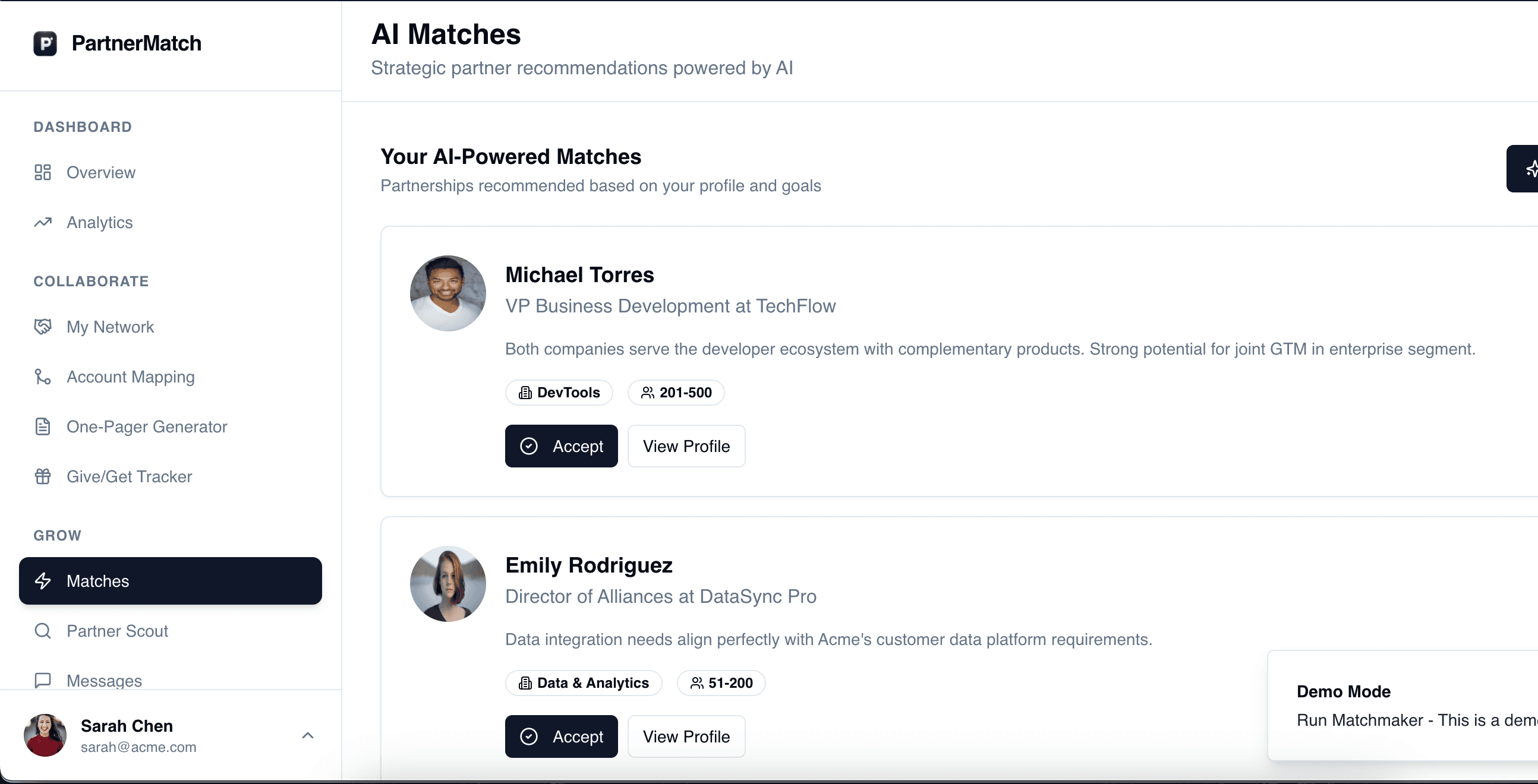
This is where PartnerMatch.co fits. Instead of hiring SDRs to cold call customers, you use our platform to identify the Nodes (Agencies, Tech Platforms, Cloud Reps) that already hold the keys to your market.
The Verdict
Hiring a sales team is an addiction to control. You control the script, the activity, the hiring. Building an ecosystem is an exercise in leverage. You give up some control, but you gain infinite reach.
In 2026, the most valuable companies will be the ones with the smallest headcount and the largest network.