Product Leaders
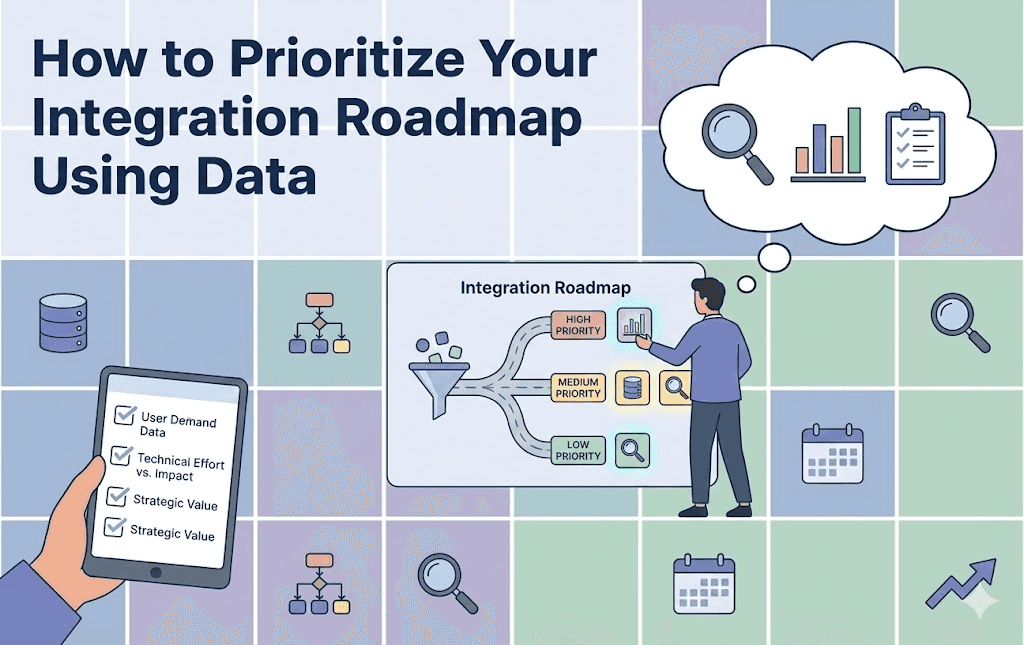
How to Prioritize Your Integration Roadmap Using Data
Date
Sep 15, 2025
Author
Matt Astarita
Struggling with a backlog of 50 integration requests and no idea which one to build next? Let's clear the air. The modern, effective way to handle this is surprisingly simple: ignore the "loudest voice" in the room and focus on RICE Scoring for Ecosystems.
This isn't about guessing anymore. It's about using hard data to build the integrations that actually drive revenue.
Rethinking Your Roadmap Strategy
The old days of building an integration just because a big customer asked for it are long gone. Thank goodness.
Think of your roadmap like an investment portfolio. Your engineering hours are your capital. If you invest them in a low-yield asset (an integration nobody uses), you burn cash. If you invest them in a high-yield asset (an integration that reduces churn by 20%), you compound value.
This tight focus helps you avoid the "Feature Factory" trap. It ensures every line of code connects to a revenue outcome, which is exactly what you need to do to survive in 2026.
The Problem: The "Loudest Voice" Syndrome
When you don't use data, you default to politics.
The Sales Leader: "We need Salesforce or we can't close this Enterprise deal!"
The CS Leader: "We need Zendesk or our support team will quit!"
The CEO: "I saw a cool AI tool on Twitter, let's integrate with that!"
Trying to satisfy everyone results in a roadmap that looks like a Frankenstein monster, half-finished integrations that don't talk to each other. This triggers "Maintenance Debt," where your engineers spend 100% of their time fixing old APIs instead of building new value.
Your Prioritization Framework at a Glance (RICE 2.0)
This table breaks down the modified RICE score specifically for partnerships.
Metric
| Definition for Ecosystems
| Data Source
|
Reach
| How many current customers use this partner tool?
| Crossbeam / PartnerMatch.co overlap data.
|
Impact
| What is the revenue lift? (Retention or New Sales)
| CRM Win Rates / Churn analysis.
|
Confidence
| Do we know this, or are we guessing?
| Customer surveys / Intent signals.
|
Effort
| How hard is the build?
| API Documentation analysis (AI Scan).
|
By following this simple framework, you’ll be creating a roadmap that’s not just technically feasible but commercially lethal.
1. Calculating "Reach" (The TAM Overlap)
Before we even think about how to build, we have to get clear on who cares.
Reach is your Total Addressable Market (TAM) overlap.
Reactive Method: Count how many times "HubSpot" appears in your support tickets. (Slow).
Proactive Method: Use an Account Mapping tool to run a blind overlap.
Formula: (Number of Mutual Customers) / (Total Customers) = Ecosystem Penetration %.
If Partner A has a 2% overlap and Partner B has a 40% overlap, the debate is over. You build Partner B.
Pro Tip: Don't just count logos. Count Revenue Overlap. A 5% overlap with Enterprise customers might be worth more than a 20% overlap with SMBs.
2. Calculating "Impact" (The Revenue Lever)
Reach tells you who uses it. Impact tells you if it matters.
You need to define the business goal of the integration. Is it for Stickiness (Retention) or Sales (Acquisition)?
Retention Impact: Look at customers who have requested this. Are they "At Risk"? If you build this, does it save $1M in ARR from churning?
Acquisition Impact: Look at "Closed Lost" deals. How many times was "Missing Integration X" the reason for losing the deal?
[Internal Link Opportunity]: Link this section to Article #25: "3 Metrics That Actually Matter" to dive deeper into calculating Partner Attach Rate.
3. Calculating "Effort" (The Technical Reality)
This is where most Product Leaders fail. They underestimate the build.
"Effort" isn't just writing the code. It is maintaining the code.
Use AI to audit the partner's API before you commit.
Low Effort: Modern REST API, robust Webhooks, clear Documentation, Sandbox available.
High Effort: SOAP API, no Sandbox, rate limits are strict, documentation hasn't been updated since 2022.
The "Hidden" Effort Multiplier:
If the partner requires you to undergo a security review (e.g., Google OAuth verification), add 4 weeks to your timeline estimate.
[Internal Link Opportunity]: Link this section to Article #18: "How to Use AI to Analyze Tech Stack Compatibility" to learn how to automate this check.
4. The Decision Matrix: Putting It All Together
Once you have your RICE score, plot your options on a simple 2x2 matrix.
Quadrant 1: The "Do Now" (High Impact / Low Effort)
Action: These are your quick wins. Usually "Long Tail" integrations or upgrades to existing popular connectors.
Example: Adding a "Slack Notification" feature.
Quadrant 2: The "Strategic Bets" (High Impact / High Effort)
Action: These go on the roadmap for next quarter. They require spec docs and dedicated resources.
Example: A full bi-directional sync with Salesforce.
Quadrant 3: The "Zapier Zone" (Low Impact / Low Effort)
Action: Do not build these natively. Use an iPaaS (Integration Platform as a Service) or "Embedded" partner to handle them.
Rule: If fewer than 50 customers need it, it belongs on Zapier, not in your codebase.
Quadrant 4: The "Time Wasters" (Low Impact / High Effort)
Action: Kill immediately.
Example: A custom integration for a single legacy enterprise client.
[Internal Link Opportunity]: Link this section to Article #41: "Build vs. Partner" for the strategic framework on when to outsource.
The "Hidden" Variable: Strategic Leverage
Sometimes, the data says "No," but the Strategy says "Yes."
The IPO Prep: If you are planning to go public, you might need to integrate with SAP/Oracle just to check the "Enterprise Ready" box, even if user adoption will be low.
The Acquisition Target: If you want to be bought by HubSpot, you better have the best HubSpot integration on the market, regardless of the RICE score.
The Verdict for 2026
Your roadmap is a zero-sum game. Every "Yes" is a "No" to something else.
Stop building based on feelings. Start building based on Overlap, Intent, and Effort.
The Product Leaders who win this year won't be the ones who built the most integrations. They will be the ones who built the right ones.