Metrics, Data & Attribution
How to Forecast Partner Revenue (Without Lying)
Date
Nov 9, 2025
Author
Matt Astarita
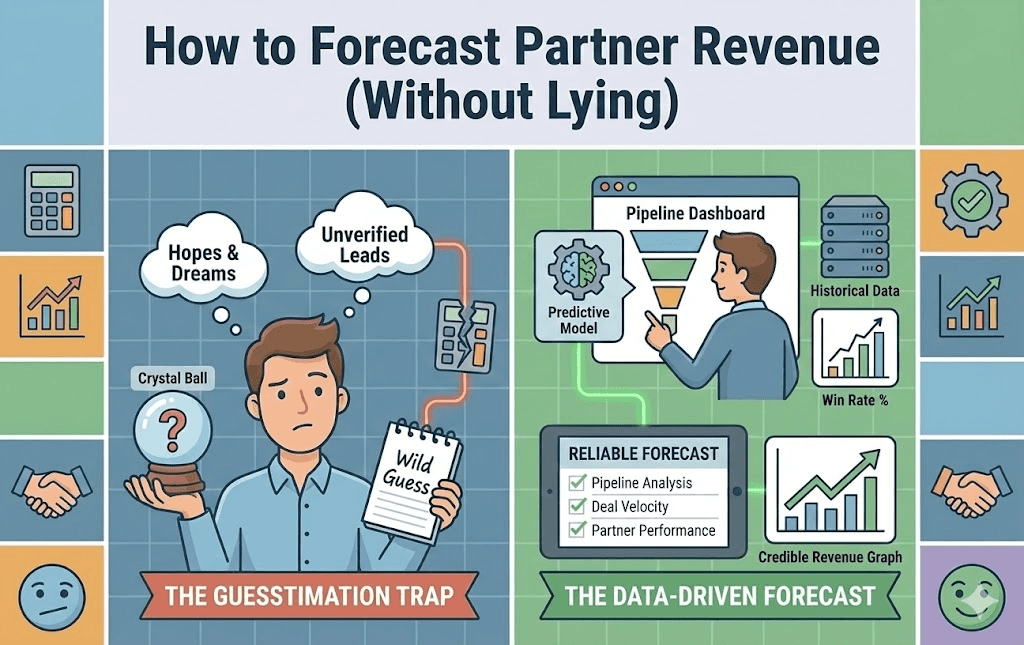
Struggling to give your CRO a number for next quarter? Let's clear the air. Forecasting Direct Sales is science (Calls $\rightarrow$ Demos $\rightarrow$ Deals). Forecasting Partner Sales is usually fiction.
Partners are notorious for "Pipeline Stuffing." They dump 50 "leads" into your portal to look busy before a QBR.
You report $1M in pipeline to your Board.
You close $50k.
You get fired.
In 2026, "Hope" is not a strategy. You cannot control your partners, but you can control your math.
Here is the rigorous framework for forecasting channel revenue without destroying your credibility.
The "Trust Discount" (The Haircut)
You cannot value a Partner Opportunity the same way you value a Direct Opportunity.
If a Direct Rep puts a deal in "Stage 3 (Negotiation)," it has a 60% chance to close.
If a Partner puts a deal in "Stage 3," it might have a 10% chance. Or 90%. It depends on who the partner is.
The Fix: Apply a Partner Reliability Score (PRS).
$$Forecast = Deal Value \times Stage Probability \times PRS$$
Partner Tier
| Behavior
| PRS (Multiplier)
|
Tier 1 (Elite)
| They only register real deals. They close 80% of what they bring.
| 1.0 (No Discount)
|
Tier 2 (Active)
| Good intent, but sometimes overly optimistic.
| 0.7 (30% Haircut)
|
Tier 3 (Long Tail)
| They register "coffee chats" as "deals."
| 0.2 (80% Haircut)
|
The Strategy:
When you present the number to the CFO, say: "The raw pipeline is $5M. But based on our historical Partner Reliability Scores, the Risk-Adjusted Forecast is $2.1M."
This shows you are a realist, not a cheerleader.
Separation of Church and State (Run Rate vs. Whales)
Channel revenue behaves in two different ways. You must forecast them separately.
1. The Run Rate (The Flow):
This is the high-volume, low-ACV business (e.g., SMB agencies referring $500/mo accounts).
Forecasting Method: Historical Trend Analysis.
Logic: "We did 50 deals in Q1, 55 in Q2. We project 60 in Q3."
Do not look at the pipeline names. Just look at the slope of the line.
2. The Whales (The Lumpy):
This is the low-volume, high-ACV business (e.g., A GSI bringing a $200k Enterprise deal).
Forecasting Method: Binary Assessment.
Logic: Go through every single deal >$50k. Call the partner. Ask "The Hard Questions." (See below).
If the answers are weak, forecast it at $0.
[Internal Link Opportunity]: Link this section to Article #86: "Benchmarking Your Program" to align run rates with industry standards.
The "Stale Date" Kill Switch
Partners create deals and forget about them.
If you pull a report and see 50 deals created 6 months ago that are still in "Stage 1," your forecast is garbage.
The Rule:
If a Partner Opportunity hasn't moved stages in 60 days, it is automatically removed from the Forecast (moved to "Stalled/Nurture").
Action: Automate this in your PRM/CRM.
Result: Your pipeline drops by 40% overnight. This is painful, but healthy. It removes the "Zombie Revenue."
The "Commit" vs. "Upside" Interrogation
In your QBRs, stop asking "What’s in the pipe?"
Start asking "What is your Commit?"
The Interrogation Script:
"Partner X, you have $500k in open pipe.
I need to report a number to my CFO on Monday.
Which of these deals would you bet your own money on closing by Sept 30th?"
The Commit: The deals they swear by. (Forecast these).
The Upside: Everything else. (Keep these in your back pocket, but do not promise them to the Board).
Social pressure forces honesty. They don't want to look like liars next quarter.
[Internal Link Opportunity]: Link this section to Article #84: "QBRs that Partners Actually Want to Attend" to integrate this script.
The Seasonality Trap
Partners are businesses too. They have seasonality.
Consultancies: They go dead in August (Europe vacation) and December.
Agencies: They are frantic in November (Black Friday prep for clients) and don't sell software.
The Adjustment:
If you flat-line your forecast across Q3 and Q4, you will miss.
Q3 Forecast: Apply a "Summer Slump" discount (e.g., -15%).
Q4 Forecast: Apply a "Year-End Flush" accelerator (e.g., +20% for budget flushes).
The Verdict for 2026
Better to be Conservative and Right than Optimistic and Wrong.
If you promise $1M and deliver $800k, you lose your budget.
If you promise $700k and deliver $800k, you are a hero.
Your job is not to hype the channel. It is to predict the channel. Use the haircut. Kill the zombies. Trust the math, not the partner.