Tactical Execution
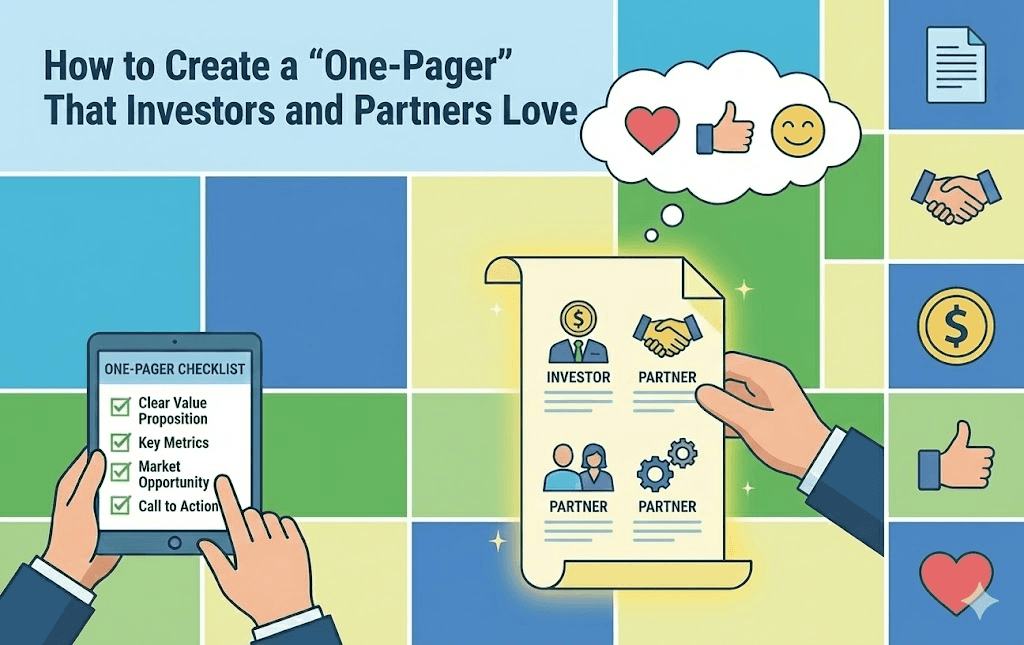
How to Create a "One-Pager" That Investors and Partners Love
Date
Sep 13, 2025
Author
Matt Astarita
In the modern B2B world, attention is the scarcest resource.
When you send a potential partner (or an investor) a link, they do not open the 20-slide deck. They open the One-Pager.
This document is your secret weapon. It is the single-source-of-truth that translates your complex business model into a 60-second read. If you cannot distill your entire value proposition down to a single page, you don't truly understand your own partnership model.
The goal of the One-Pager is not to close the deal. The goal is to get the next meeting with the right person.
Here is the exact structure for a 2026-optimized Partnership One-Pager that drives action.
Jump to a section:
The Goldilocks Rule: Less is More
The 4 Essential Sections (The AIDA Framework)
The Final CTA (The Single Ask)
1. The Goldilocks Rule: Less is More
A One-Pager should be exactly one page. Not two. Not a PDF that links to a massive Google Drive folder.
Wrong: A document that lists all 50 benefits of your product.
Right: A document that lists the Top 3 Problems you solve for their specific customer.
The format should be clean, high-contrast, and easy to scan on a phone. Treat it like an Executive Summary with a laser focus on mutual gain.
[Internal Link Opportunity]: Link this section to Article #7: "Quality vs. Quantity" to emphasize that precision beats volume in information sharing.
2. The 4 Essential Sections (The AIDA Framework)
Organize your One-Pager using a modified AIDA (Attention, Interest, Desire, Action) framework, tailored for partnerships:
Section 1: The Hook (Attention/Problem)
Goal: Instantly grab their attention by framing the problem you solve for their customers.
Content:
Headline: Must be outcome-focused (e.g., "The integration that reduces churn by 15%").
The Shared Pain Point: Identify the common struggle of your mutual customer (e.g., "Our shared customers lack visibility between X and Y.").
Section 2: The Proof (Interest/Solution)
Goal: Use data to establish credibility and show how you fix the pain point.
Content:
The "Better Together" Story: A single, concise sentence (e.g., "Our real-time data sync, combined with your automated workflows, saves teams 10 hours a week.").
The Social Proof: One key metric (e.g., "95% of joint customers rate this integration as 'Critical'") or one recognizable logo.
Section 3: The Money (Desire/Incentive)
Goal: Show them how they get paid—in money, time, or customer happiness.
Content:
Financial Incentive: Is it 20% commission? Quota retirement? New logo acquisition? Be explicit.
Value Proposition: List 3 key outcomes for them:
New Revenue Stream.
Reduced Customer Churn.
Increased Deal Size.
Section 4: The Strategic Fit (Trust/Intent)
Goal: Confirm that this isn't a random pitch—you did your homework.
Content:
Ideal Customer Profile (ICP) Overlap: A simple visual (e.g., a Venn Diagram showing shared target industries/segments).
Tech Compatibility Score: State that your AI pre-vetted their API.
[Internal Link Opportunity]: Link this section to Article #18: "How to Use AI to Analyze Tech Stack Compatibility" to establish technical credibility instantly.
3. The Final CTA (The Single Ask)
End with a crystal-clear, single ask. Do not give them three options.
Wrong: "Would you like to chat, see a demo, or read our docs?"
Right: "Let’s schedule 15 minutes to run an Account Overlap Report to validate the mutual revenue opportunity."
[Internal Link Opportunity]: Link this section to Article #21: "5 Strategic Intent Questions" to funnel them directly into a qualified discovery call.
The goal is to move the conversation from information to validation.
The Verdict
Your One-Pager is your first date. Keep it short, focused, and irresistible. If you overwhelm them, you lose them. If you intrigue them, you win the second date.
In 2026, the biggest deals start with the smallest document.