Future Trends
How AI is Rewriting the Rules of B2B Alliances
Date
Sep 12, 2025
Author
Matt Astarita
For decades, the "Rulebook" of B2B alliances was unwritten but understood.
Rule 1: Business happens on the golf course (or at the steakhouse).
Rule 2: The biggest Rolodex wins.
Rule 3: Trust is built over years of face-to-face interaction.
In 2026, those rules aren't just outdated—they are liabilities.
The speed of the market has outpaced the speed of human relationship building. If you are waiting to build a 3-year relationship before signing a partnership agreement, your competitor has already used AI to identify the opportunity, integrate the API, and close the customer.
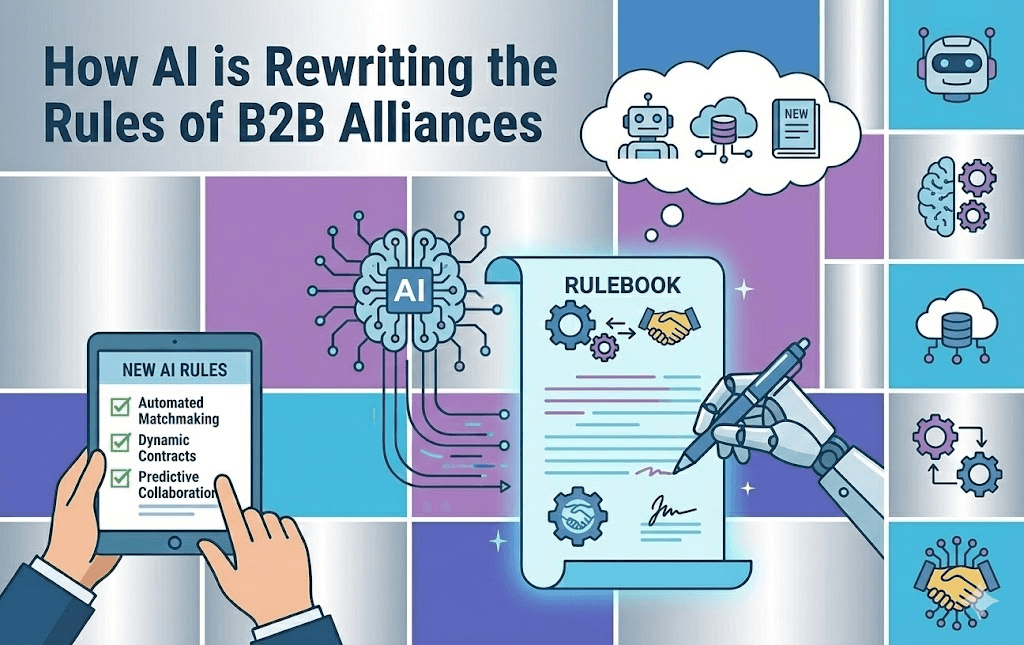
Artificial Intelligence isn't just automating the old game; it is inventing a new sport. Here are the three new rules of B2B alliances.
Jump to a section:
Rule #1: Data First, Dinner Second
Rule #2: Prediction Over Prospecting
Rule #3: The "Universal Translator" Effect
Rule #1: Data First, Dinner Second
In the old world, you met for coffee to "explore synergies." You spent an hour chatting to figure out if there was a fit. [Internal Link Opportunity]: Link this to Article #2: "The Coffee Chat Trap" to reinforce why this is a waste of time.
In the AI era, this is backward. You don't meet to find the fit; you meet to execute the fit.
AI tools can now instantly analyze two companies and calculate the "Overlap Coefficient":
Customer Overlap: Do we share the same clients?
Tech Stack Overlap: Can our products talk to each other?
GTM Overlap: Do we sell to the same personas?
The New Rule: Never schedule a meeting without a "Data Pre-Read." If the algorithm says the compatibility score is low, skip the coffee. If it’s high, skip the small talk and get straight to the go-to-market strategy.
Rule #2: Prediction Over Prospecting
Traditional business development is reactive. You wait for a partner to announce a program, or you cold email them hoping for good timing. [Internal Link Opportunity]: Link this to Article #1: "Why 90% of Your Partnership Emails Are Being Ignored" to highlight the failure of reactive outreach.
AI changes this by becoming Predictive.
Generative Agents can monitor millions of data points to predict who needs to partner with you before they even know it themselves.
Signal: "Company X just hired a VP of Sales in Germany."
Prediction: They will need local agency partners and compliance software within 90 days.
Action: Your AI alerts you to reach out now with a localized offer.
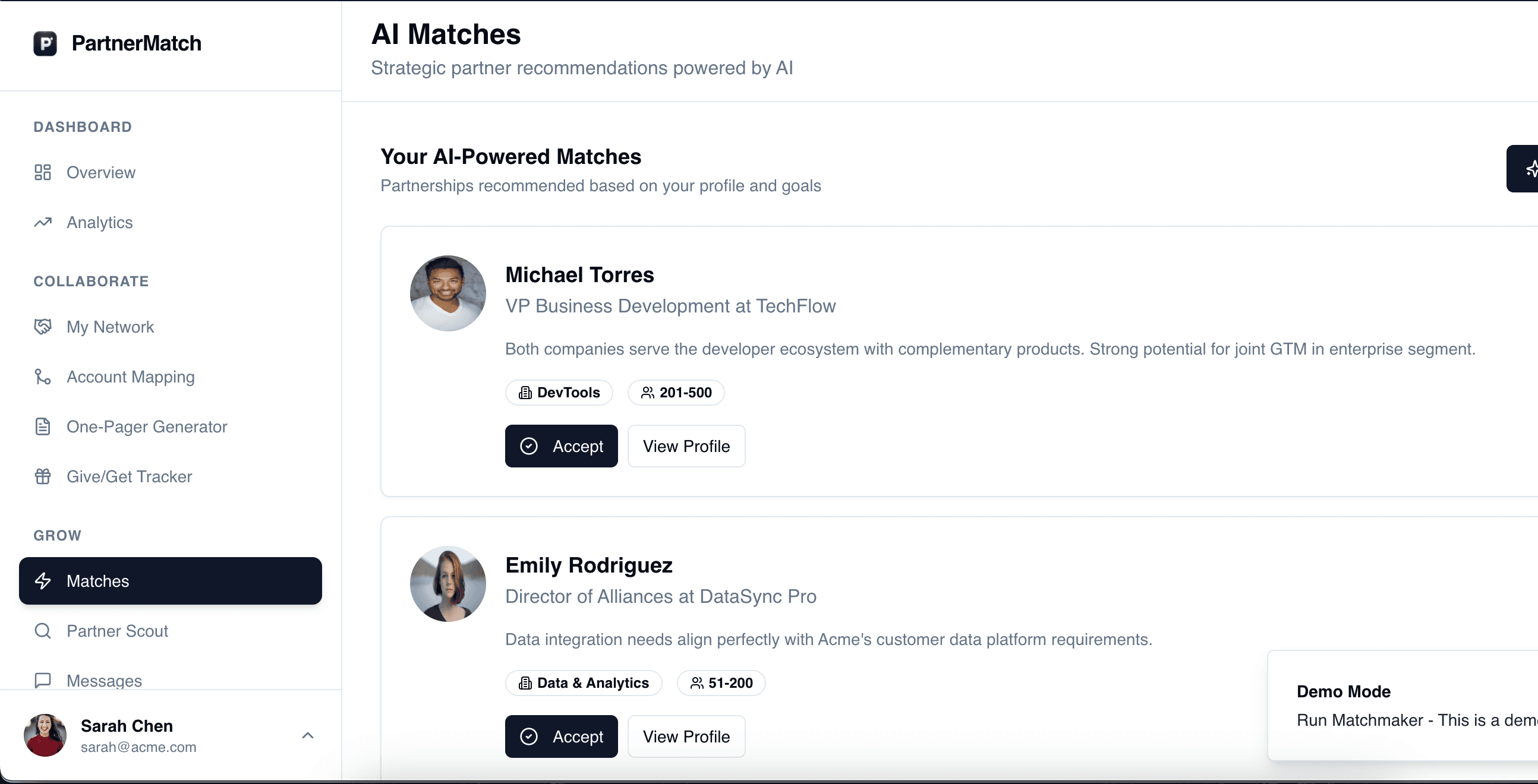
This is the core engine of PartnerMatch.co. We don't wait for you to search for partners. We surface matches based on Strategic Intent signals that humans often miss.
Rule #3: The "Universal Translator" Effect
One of the biggest friction points in alliances is language. Not English vs. French, but Sales vs. Product.
Partnership Managers speak in "Revenue" and "Leads."
Product Managers speak in "APIs" and "Endpoints."
Marketing Leaders speak in "MQLs" and "Attribution."
Deals often die because these departments can't agree on the value.
AI is acting as the Universal Translator. You can feed technical API documentation into an LLM and ask it to "Write a pitch for a VP of Sales explaining the revenue impact of this endpoint." Suddenly, technical constraints are translated into business opportunities instantly.
⚡ Pro-tip: Use AI to rewrite your "Better Together" story for every stakeholder. Send the CTO the technical specs, and send the CRO the revenue projection—all generated from the same core data.
The Verdict
The "Old Boys' Club" of partnerships is closing. The "Algorithm Club" is open for business.
This doesn't mean relationships are dead. It means that relational capital is now reserved for the highest-value interactions.
AI handles the sorting, the matching, and the predicting. You handle the trust.
If you are still playing by the old rules, you aren't just losing time, you are losing the future.