Product Leaders (Integration)
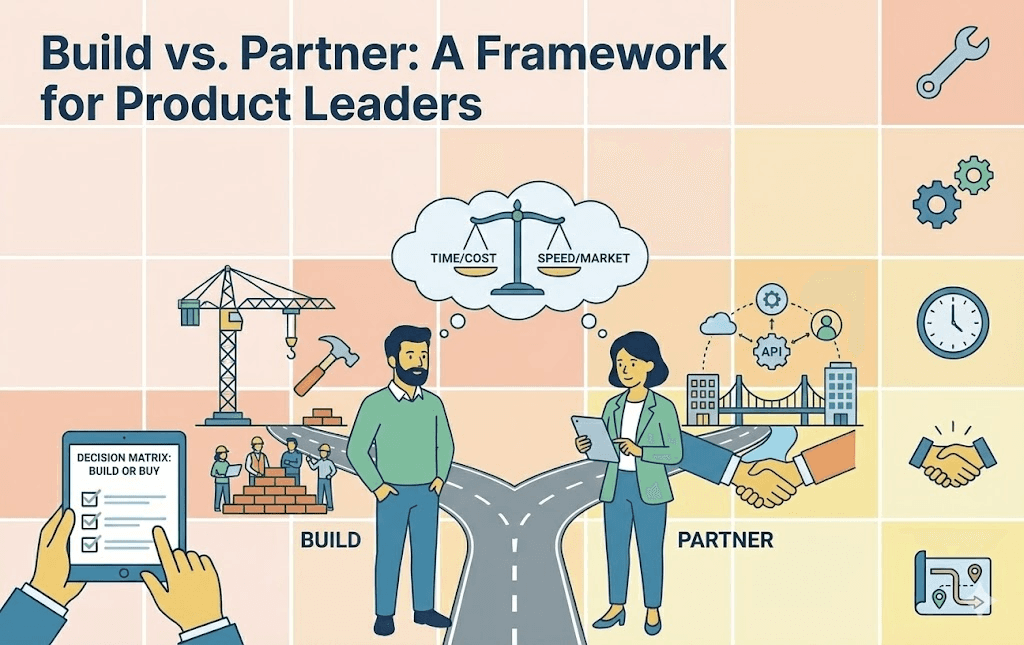
Build vs. Partner: A Framework for Product Leaders
Date
Sep 5, 2025
Author
Matt Astarita
In 2026, the "Build vs. Buy" debate has become the "Build vs. Partner" debate.
With AI coding assistants, the cost to build a feature has dropped to near zero. An engineer can generate a basic "Chat Widget" or "Kanban Board" in an afternoon.
This has created a dangerous trap for Product Leaders. Just because you can build it, doesn't mean you should.
The initial build is the cheap part. The Maintenance Tax—security patches, API updates, bug fixes, and customer support—is the expensive part. If you build non-core features, you are slowly turning your engineering team into a maintenance team.
Here is the decision framework for the modern Product Leader: When to code it yourself, and when to let an ecosystem partner handle it.
Jump to a section:
The "Core vs. Context" Matrix
The Hidden Cost of "Tech Debt"
The "Integration" Middle Ground
How to Sell "Not Building" to Your CEO
1. The "Core vs. Context" Matrix
To make this decision, you must be ruthlessly honest about what your product actually is. Use Geoffrey Moore’s framework, updated for 2026:
1. Core (Your Differentiator)
Definition: This is the reason customers buy you. It is your secret sauce.
Action: Build it. Never outsource your soul.
Example: If you are Zoom, you build video compression. You do not partner for that.
2. Context (Necessary but Generic)
Definition: Features customers expect, but don't buy you for.
Action: Partner.
Example: If you are Zoom, you need a "Calendar" feature. But nobody buys Zoom for the calendar. Therefore, you integrate with Google/Outlook. You do not build "Zoom Calendar."
The Trap: Most Product Managers convince themselves that everything is Core. "Our customers need a specific type of billing!" -> So you build a billing engine. Now you are a Billing Company, not a CRM company. You have lost focus.
[Internal Link Opportunity]: Link this section to Article #34: "Why Your First 10 Partners Define Your Company’s Trajectory" to show how partnering for "Context" features defines your market position.
2. The Hidden Cost of "Tech Debt"
In 2026, building a feature creates a permanent liability.
Let’s say you decide to build a native "E-Signature" feature instead of partnering with DocuSign or PandaDoc.
Day 1: It works. Everyone is happy.
Month 6: A customer needs "Qualified Electronic Signatures" for EU compliance. You have to build it.
Year 1: A security vulnerability is found in the library. You have to patch it.
Year 2: Competitors (DocuSign) launch AI-analysis features. Your home-grown version looks outdated.
You are now spending 20% of your engineering roadmap maintaining a feature that is worse than the market standard.
The Rule: If you cannot afford to be the best in the world at that feature, do not build it. Partner with the company that is.
3. The "Integration" Middle Ground
The binary choice of "Build vs. Partner" often misses the best option: Embed.
In 2026, API-first architecture allows you to look like you built it, while a partner powers it.
White-labeling: You use a partner’s API to render the feature in your UI.
The Benefit: You own the User Experience (UX), but they own the Maintenance.
Strategic Fit: Before you commit to an integration, use AI to scan their docs. Is their API robust enough to be embedded? Or is it a flimsy wrapper?
[Internal Link Opportunity]: Link this section to Article #18: "How to Use AI to Analyze Tech Stack Compatibility" to validate if a partner’s tech is "Embed-Ready."
4. How to Sell "Not Building" to Your CEO
CEOs usually want to build. They think it increases enterprise value (IP). You need to explain that it actually decreases velocity.
The Script:
*"We could build this e-signature feature. It will take 3 engineers for 2 months. Or, we could integrate with Partner X in 2 weeks.
If we partner, we free up those 3 engineers to work on [Project Alpha]—which is our actual competitive advantage. Plus, Partner X has agreed to co-market us to their 50k users, driving net-new revenue."*
Frame the decision as Resource Allocation + Distribution, not just "Laziness."
[Internal Link Opportunity]: Link this section to Article #29: "How to Pitch Your Product to a Potential Integration Partner" to show how to turn that integration into a growth lever.
The Verdict
Your engineering capacity is your most scarce resource.
Every line of code you write is a line of code you have to debug forever. Be stingy with your "Build" budget. Be generous with your "Partner" budget.
The best Product Leaders in 2026 don't just manage a roadmap; they manage an Ecosystem of Capabilities.