Metrics, Data & Attribution
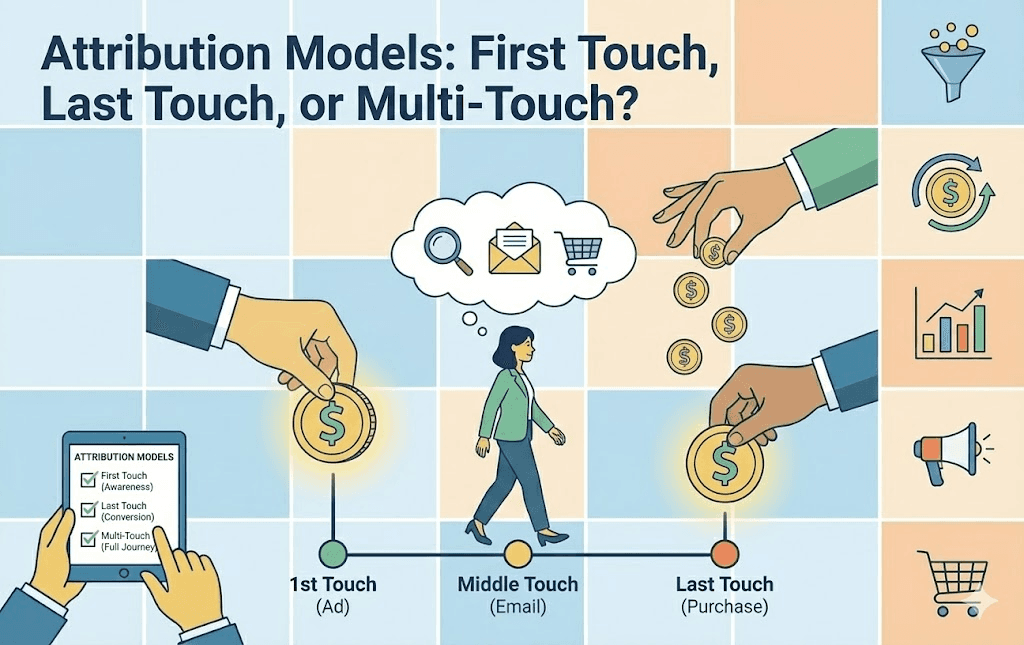
Attribution Models: First Touch, Last Touch, or Multi-Touch?
Date
Sep 19, 2025
Author
Matt Astarita
Struggling to prove your worth because Marketing claims they "sourced" every single lead? Let's clear the air. Attribution is not science. Attribution is politics.
In 2026, the customer journey is a chaotic mess of 40+ touchpoints.
They saw a LinkedIn ad (Marketing).
They talked to a Consultant (Partner).
They Googled your brand (SEO).
They booked a demo (Sales).
Who gets the credit?
If you use the wrong model, your Partnership team looks invisible. If you use the right model, you look like the engine of the company.
Here is how to rig the game (fairly) so you get paid for the value you actually create.
The "First Touch" Trap (Marketing Wins)
Most B2B companies default to First Touch Attribution.
The Logic: Whoever introduced the brand first gets 100% credit.
The Problem: Partners often don't introduce the Brand; they introduce the Trust.
Scenario: A prospect sees your ad (First Touch: Marketing). They ignore it. Six months later, their trusted Agency Advisor says: "You really need to use [Your Tool]." They buy.
Result: Marketing gets $100k credit. You get $0.
Verdict: First Touch is fatal for Ecosystem teams.
The "Last Touch" Trap (Sales Wins)
The Logic: Whoever touched the lead right before the "Closed-Won" status gets credit.
The Problem: This is usually the Account Executive (AE) or a "Book a Demo" button.
Result: Sales claims they "self-sourced" it. You get $0.
The 2026 Solution: The "Partner Attached" Overlay
Stop fighting Marketing for the "Source" field. You will lose.
Instead, create a parallel track.
In 2026, the smartest companies don't put "Partner" in the Lead Source dropdown. They use a "Partner Attached" object.
This is a binary flag (Yes/No) that sits on top of the deal, regardless of who sourced it.
The 3 Buckets of Truth:
Bucket
| Definition
| The Credit
|
1. Partner Sourced
| The Partner explicitly registered the lead via the portal before it existed in CRM.
| 100% Attribution. (The Gold Standard).
|
2. Partner Influenced
| The lead existed, but the Partner was active (meetings/emails) during the sales cycle.
| "Influence Revenue" (Secondary KPI).
|
3. Partner Assisted
| The deal was "Stalled/Closed Lost," and the Partner revived it.
| "Resurrection Revenue" (The Hero Stat).
|
The "W-Shaped" Model (The Fair Compromise)
If your CMO is sophisticated, push for W-Shaped Attribution.
This gives credit to the three critical moments:
First Touch: (Marketing Ad) - 30% Credit.
Lead Creation: (Partner Intro) - 30% Credit.
Opportunity Creation: (Sales Demo) - 30% Credit.
Nurture: (The rest) - 10% Credit.
This acknowledges that while Marketing might have "generated awareness," the Partner "generated the meeting."
The "Shadow Funnel" (Dark Social)
Attribution software (HubSpot/Marketo) tracks digital clicks.
Partnerships happen in analog conversations.
A text message.
A dinner conversation.
A Slack DM.
The Tracking Hack:
You must train your Sales Reps to ask "The Question" on every demo call.
"How did you hear about us?"
If the prospect says, "My consultant, Sarah, recommended you," the Rep must manually tag Sarah in the CRM.
If you rely on software to track offline influence, you will report zero revenue.
[Internal Link Opportunity]: Link this section to Article #52: "The Anatomy of a Perfect Match Card" to ensure partners are easy to find/tag.
The "Influence" Argument (How to Win It)
When Finance asks, "Why should we pay the partner commission if Marketing sourced the lead?"
The Answer: Because the Partner insured the deal.
Show data proving that:
Partner-Attached deals have a 20% higher win rate.
Partner-Attached deals have 15% lower churn.
You aren't paying the partner for the Lead. You are paying them for the Certainty.
[Internal Link Opportunity]: Link this section to Article #81: "The Only 3 KPIs Your CFO Cares About" to back this up with metrics.
The Verdict for 2026
Don't let the software dictate your value.
CRM default settings are designed for Marketing teams, not Ecosystem teams.
Separate "Source" from "Influence."
Manually capture "The How."
Prove the "Lift" (Higher win rates).
If you can't measure it, you can't manage it—and you certainly can't get paid for it.